
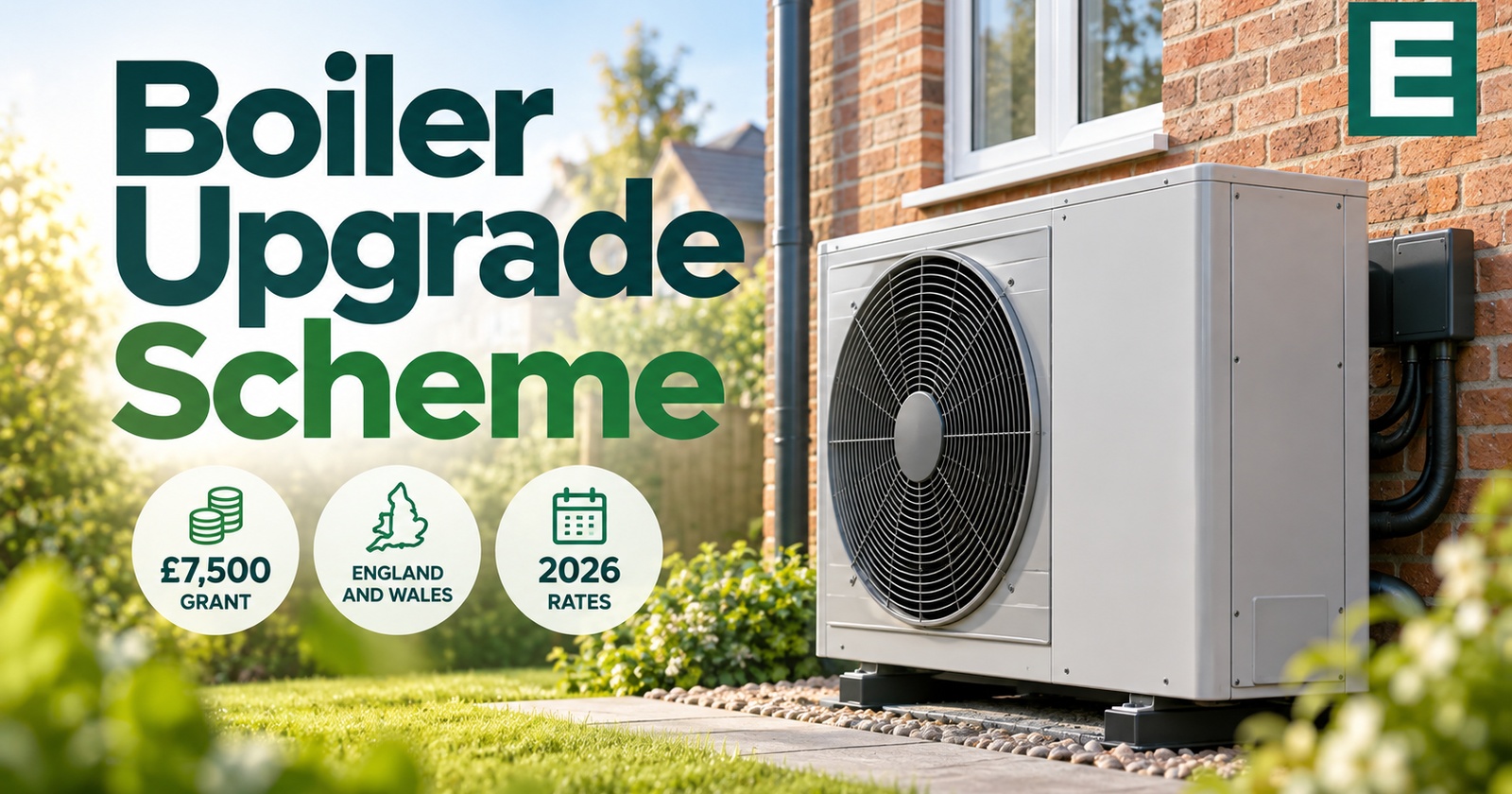
What the Boiler Upgrade Scheme pays in 2026
The Boiler Upgrade Scheme is the main government grant for replacing fossil fuel heating in England and Wales. It is administered by Ofgem, it has no income test, and since April 2026 it no longer requires a valid Energy Performance Certificate. For most households it knocks £7,500 straight off the quote for an air source heat pump, which changes the arithmetic considerably once you have seen what a heat pump actually costs to install.
It is not free money and it does not cover the whole job. This page sets out what the scheme pays, who qualifies, the disqualifiers that catch people out, and the two things nobody selling you a heat pump will mention.
| Technology | Grant | Notes |
|---|---|---|
| Air source heat pump (air-to-water) | £7,500 | The standard route for most homes |
| Ground source heat pump | £7,500 | Includes water source and shared ground loops |
| Air-to-water or ground source, off-gas oil or LPG home | £9,000 | Temporary uplift, ends 31 March 2027 |
| Biomass boiler | £5,000 | Rural properties never connected to the gas grid |
| Air-to-air heat pump | £2,500 | Residential only, added April 2026 |
One grant per property. The scheme runs to 2030, and the budget rises each year, from £400 million in 2026/27 to £709 million in 2029/30.
What changed in April 2026
The scheme had its largest rewrite since launch when the Boiler Upgrade Scheme (England and Wales) (Amendment) Regulations 2026 came into force on 28 April 2026. Four changes matter:
- The EPC requirement is gone. Previously a property needed a valid EPC with no outstanding loft or cavity wall insulation recommendations. That single rule killed more applications than anything else. Now, if you have a current EPC the certificate number is submitted; if you do not, your installer provides alternative evidence instead, typically a recent utility bill showing your fuel type plus dated photographs of the existing system.
- Air-to-air heat pumps became eligible at £2,500, in residential properties only.
- The scheme was extended to 2030, replacing the previous 2028 end date.
- MCS certification is now written into the regulations rather than sitting in guidance, so only MCS-certified businesses can claim.
If you were told in 2024 or 2025 that your insulation recommendations blocked your application, that advice is now out of date and worth revisiting.
Who qualifies
Your property
It must be in England or Wales. Scotland and Northern Ireland run separate schemes, covered further down. Social housing is excluded, and so are new builds, with one exception: self-builds qualify if the property was built mainly using the labour or resources of the first owner, has never been owned by a business or organisation, and is not part of an excluded property development.
Your existing heating
The heat pump must replace an existing fossil fuel or electric heating system, and it must replace it fully. Mains gas, oil, LPG, coal and electric resistance heating all qualify as the outgoing system. Properties already running on biomass do not, because they are already counted as low carbon.
The installation itself
The requirements that most often trip up a quote:
- Air-to-water and ground source heat pumps need a minimum seasonal coefficient of performance (SCOP) of 2.8
- The system must be sized to meet the full space heating needs of the property, and capable of meeting space heating and hot water needs either alone or with a supplementary appliance
- Any supplementary heating must not be fossil fuelled
- Maximum capacity of 45kWth, or 70kWth as a cascade system
- The product must appear on the Boiler Upgrade Scheme Product Eligibility List, a subset of the MCS list
- The system must not have been used before commissioning, other than in narrow cases such as drying out plasterwork
The disqualifiers worth knowing before you get quotes
These are the ones that turn a signed quote into a rejected voucher:
- Hybrid systems are not eligible. A heat pump kept alongside a working gas boiler does not qualify. The old system goes.
- You cannot stack public funding. If you have received another grant from public funds towards the purchase or installation, the BUS grant is off the table. Anything funded through the Energy Company Obligation is excluded too.
- The heating must serve only the applied-for property. Extending it to an annexe, outbuilding or swimming pool breaks the rules.
- You must own the system after installation. Rental and lease arrangements do not qualify.
- Biomass has extra conditions. Rural location, never connected to the gas grid, an emissions certificate, and it must meet the full space and water heating needs on its own. It cannot go in a self-build.
The £9,000 uplift for oil and LPG homes
Households off the gas grid replacing oil or LPG heating can currently claim £9,000 rather than £7,500, for an air-to-water or ground source heat pump only. It runs until 31 March 2027.
The definition of off-gas grid is stricter than most people assume. A capped or clamped gas meter still counts as being fuelled by mains gas, and so does any record of an existing gas meter point at the property. Homes attached to a heat network and new builds are also excluded. If you are anywhere near this, read our full breakdown of the £9,000 oil and LPG grant, including what the deadline means for timing your installation.
How the money actually reaches you
You never handle the grant. Your installer applies to Ofgem on your behalf and must pass the full value on as an upfront discount, showing it on the quote before installation and again on the final invoice. Installers are explicitly barred from requesting or accepting the grant value from you.
The sequence runs like this:
- You get quotes from MCS-certified installers, each showing the grant deducted
- You agree a quote and consent to your installer applying on your behalf
- Ofgem emails you directly to confirm your consent and check some eligibility details
- Ofgem issues a voucher to the installer
- The work is completed and commissioned, then the MCS installation certificate is generated
- The installer redeems the voucher and Ofgem pays out
Two timing rules matter to you. The voucher lasts three months from issue, or six months for a ground source heat pump, and if it expires before commissioning the installer has to reapply. Separately, the system must have been commissioned no more than 120 days before the voucher application is properly made.
If the Ofgem consent email does not arrive, check your spam folder before chasing the installer. It is the single most common cause of a stalled application.
What the grant does not do
Two things are worth saying plainly, because they rarely appear on installer websites.
The grant does not make a heat pump free, and the gap varies enormously. Official figures put the median installed cost of an air source system at £13,021 before the grant, with the middle half of installations costing between roughly £11,100 and £15,600, so the same £7,500 leaves one household paying a few thousand pounds and another paying eight thousand or more. The variable is your property, not the equipment: radiator sizing, pipework, cylinder space and electrical work are where the money goes. Anyone quoting you a net figure before surveying your house is guessing.
A universal grant can be absorbed into pricing. When every eligible customer has £7,500 available and the quote shows the deduction, there is nothing stopping the pre-grant figure drifting upwards to meet it. We are not suggesting this is widespread, and we have no way to measure it. But it is the obvious risk in a subsidy structured this way, and the defence is simple: get three quotes, compare the figure before the grant rather than after it, and be suspicious of any installer reluctant to show you both.
One genuine extra saving is real and time-limited. Heat pump installations currently carry 0% VAT until 31 March 2027, after which the rate is expected to return to 5%.
How much money the scheme actually has
Most guides quote a single budget figure. The real number is a four-year profile, published by DESNZ in the scheme’s business case, and it rises steeply.
| Financial year | Annual grant budget |
|---|---|
| 2025/26 | £295 million |
| 2026/27 | £400 million |
| 2027/28 | £600 million |
| 2028/29 | £683 million |
| 2029/30 | £709 million |
DESNZ, Boiler Upgrade Scheme 2026 to 2030: Summary Business Case, Table 5. Capital funding (CDEL).
The business case commits £2,392 million across the four years from 2026/27, on top of the £295 million agreed separately for 2025/26. The Warm Homes Plan, agreed at the 2025 Autumn Budget, allocated approximately £2.7 billion in total.
Three things worth knowing that the headline figure hides.
- The annual budgets are not purely household grants. DESNZ states that they include funding for the Heat Pump Ready grant, up to £30 million in total between 2026/27 and 2029/30. The amount reaching household vouchers is slightly below the headline.
- The budget is probably not the binding constraint this year. At £7,500 a grant, £400 million would fund roughly 53,000 installations. Just over 30,000 air source installations were recorded through the scheme in 2025/26, according to the official scheme statistics. That is our arithmetic rather than a government figure, and the real number will be lower because ground source, biomass and air-to-air grants are paid at different rates, but the gap is wide enough that installer capacity and household willingness look like the tighter limits.
- The money can still run short, and has. In 2024/25 the full scheme budget was used and a further £39 million was drawn from departmental capital underspend to meet demand. The Secretary of State can also cap the number of vouchers issued in a given quarter, which must be announced before that quarter begins.
You may see £625 million quoted for 2026/27. We cannot source that figure to any government publication. The business case gives £400 million, and that is what we use here.
The practical point for timing is unchanged. Allocations have been exhausted before the financial year ended in the past, so if you are planning an installation for early 2027, earlier is safer than later.
If you live in Scotland, Wales or Northern Ireland
The Boiler Upgrade Scheme covers England and Wales only. Welsh households use it in the same way English ones do, and may also qualify for the Welsh Government’s Nest scheme, which can fund the work in full. See heat pump grants in Wales for how the two interact.
In Scotland, the Home Energy Scotland Grant and Loan pays up to £7,500 towards a heat pump, rising to £9,000 for households qualifying for the rural uplift, with an optional interest-free loan of up to £7,500 on top. That makes the Scottish package more generous than the English one for most applicants. There is no income test, and your installer must be MCS certified. The process differs too: in Scotland you apply yourself rather than your installer doing it, and the measure has to be recommended in an EPC or a Home Energy Scotland report.
Northern Ireland has no direct equivalent to the Boiler Upgrade Scheme at present.
Frequently asked questions
The questions below come up most often when people are working out whether the grant applies to them.
Do I apply for the Boiler Upgrade Scheme myself?
No. The scheme is installer-led. Your MCS-certified installer applies to Ofgem on your behalf. Your only direct involvement is confirming consent and some eligibility details when Ofgem emails you.
Do I still need an EPC?
Not since 28 April 2026. If your property has a valid EPC the number is submitted with the application. If it does not, your installer provides alternative evidence instead. Outstanding insulation recommendations on an existing EPC no longer block the grant.
Can I get the grant if I am on mains gas?
Yes, at the standard £7,500 rate. The £9,000 uplift is restricted to off-gas-grid properties replacing oil or LPG.
Can I keep my gas boiler as a backup?
No. Hybrid systems combining a heat pump with fossil fuel heating are not eligible, and the heat pump must replace the existing system fully.
Can I combine the grant with other funding?
No. If you have received another public grant towards the purchase or installation costs, or the work is funded through the Energy Company Obligation, the property is not eligible.
How long does the process take?
Ofgem aims to process approved redemption claims for payment on the next weekly payment day, but that is the final step. The practical timeline is set by your installer’s schedule and the voucher window, which is three months from issue for most heat pumps and six months for ground source.
Is the grant taxable?
No. You never receive the money, so there is nothing to declare. It is applied as a discount by the installer and paid directly to them.
How much funding does the scheme have?
£400 million for the 2026 to 2027 financial year, rising to £600 million in 2027/28, £683 million in 2028/29 and £709 million in 2029/30. Those figures come from the DESNZ business case and include a small amount set aside for the Heat Pump Ready grant, so slightly less reaches household vouchers. Budgets have been used up before the end of the financial year in the past, so applying earlier in the year is safer.
What happens after March 2027?
The £9,000 uplift for oil and LPG homes ends and those households return to the standard £7,500. The scheme itself continues to 2030. The 0% VAT rate on installations is also currently set to end on 31 March 2027.
Last updated 28 September 2026. Grant values and eligibility rules verified against Ofgem’s published scheme guidance. Budget figures verified against the DESNZ Boiler Upgrade Scheme 2026 to 2030 Summary Business Case. Installation statistics verified against DESNZ Boiler Upgrade Scheme Statistics, July 2026 release. The estimate of how many installations the 2026/27 budget could fund is our own calculation. Grant figures and scheme rules change, sometimes at short notice, so check the date above before relying on anything here. Written by Ben Jardine.