
Solar is the most straightforward home energy upgrade in the UK and the one surrounded by the loosest numbers. This section covers what it actually costs, what you get paid for what you export, whether a battery is worth adding, and the cases where the honest answer is that your roof is not the right roof.
We do not fit solar panels and we do not sell them. Almost everything else written about solar is written by someone who does.
The bottom line
Solar is a better financial proposition than a heat pump for most UK homes, and we say that having spent a good deal of this site being sceptical about heat pumps. There is no grant for it, but the arithmetic works without one.
Usually yes if you have an unshaded roof facing anywhere between south east and south west, you are at home during the day, and you plan to stay put for a decade or more.
Worth calculating carefully if you are out all day. The economics turn on how much of your own generation you use rather than export, and an empty house exports most of it.
Probably not if your roof is heavily shaded, north facing, in poor repair, or if you are moving within a few years.
What it actually costs
Most cost guides give you a range with no source attached. There is a better source and hardly anyone uses it.
DESNZ publishes solar PV cost data drawn from the MCS Installation Database, covering every certified installation in Great Britain. The 2025/26 release covers roughly 177,000 domestic installations with 98% coverage. These are prices actually paid, not quotes.
| System size | Installed cost |
|---|---|
| 3 kW | £5,900 to £6,300 |
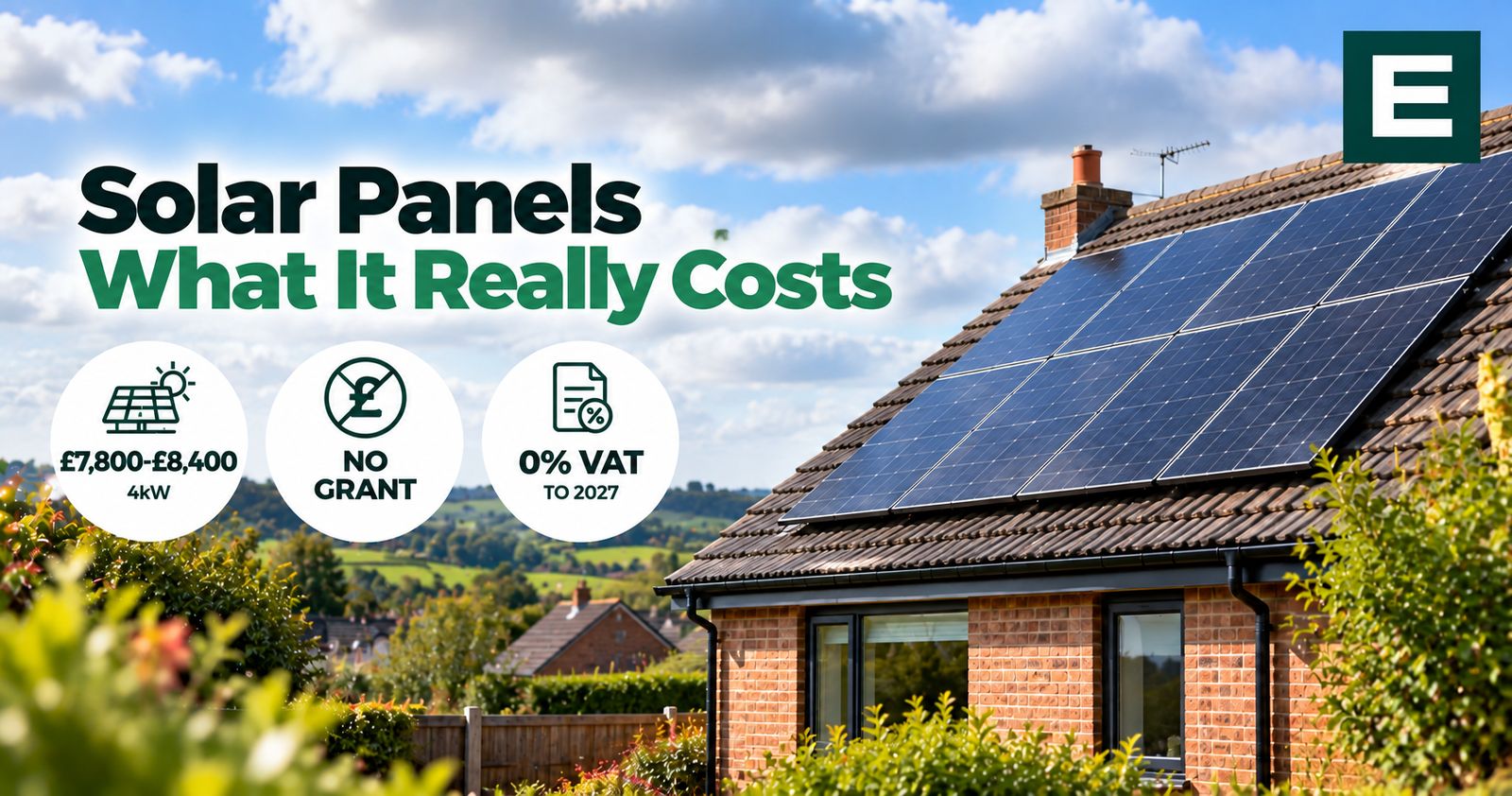
| 4 kW | £7,800 to £8,400 |
| 5 kW | £8,200 to £8,900 |
| 6 kW | £9,900 to £10,700 |
Calculated from DESNZ Solar PV cost data, 2025/26 release, domestic installations. The range reflects the two capacity measures DESNZ publishes, which is explained on our cost page.
Two things worth drawing out.
These figures are higher than the ranges most sites quote. The common figure for a 4kW system is £6,000 to £8,000. The official data puts it at £7,800 to £8,400. If you have been told to budget £6,000, the evidence says most households paid more.
Prices are falling. Domestic cost per kW dropped about 4% between 2024/25 and 2025/26, and the direction is consistent across both measures DESNZ publishes.
Our full breakdown of what solar panels actually cost sets out the per kilowatt figures, the regional variation, and the measurement question that makes most published averages unreliable.
Work out the answer for your own roof
National averages tell you what other people paid. They do not tell you whether solar pays for you, because that turns on your roof, your location and when you are at home.
Our solar payback calculator asks six questions and shows every step of the arithmetic. It uses the official cost data, the current price cap and the MCS generation method, it asks the daytime occupancy question that almost no other calculator asks, and it collects nothing from you. No email, no postcode, no phone number.
It will also tell you when the answer is no. On typical settings it returns a payback of thirteen to sixteen years, which is longer than most published calculators suggest. We explain on the page exactly which assumptions produce the shorter figures you will see elsewhere.
There is no solar grant, and that is the most useful thing to know
There is no Boiler Upgrade Scheme for solar. No voucher, no £7,500, nothing open to any homeowner regardless of income. Any site advertising a solar grant is almost always describing something else.
What actually exists:
- 0% VAT on domestic solar installations until 31 March 2027, after which the rate is expected to return to 5%. This is the only universal saving and it is time limited.
- The Smart Export Guarantee, which obliges larger suppliers to pay you for electricity you export. It is not a grant, it is a price, and the price varies enormously between suppliers.
- Means-tested schemes that can include solar for eligible low income households: ECO4 until 31 December 2026, Nest in Wales, and the Home Energy Scotland Grant and Loan, which covers solar and battery storage.
For most households, solar is a self-funded purchase. That is not a problem, it just means the case has to stand on the arithmetic rather than on a subsidy.
The number that decides it
This is the point most solar guides skate over, and it matters more than the panels, the brand or the roof.
Under the Ofgem price cap for 1 October to 31 December 2026, electricity costs around 26.32p per kWh to import. Export rates under the Smart Export Guarantee vary by supplier, and the spread between the worst and the best is several times over.
So a unit of your own generation is worth roughly 26p if you use it and considerably less if you export it. The proportion you use rather than export is called self-consumption, and it is the single biggest variable in whether solar pays.
Two households with identical roofs, identical systems and identical bills can get payback periods years apart purely on this. Anyone quoting you a single payback figure without asking about your daytime occupancy is guessing.
We work through the arithmetic in full, with the assumptions stated, in are solar panels worth it. The short answer is that payback runs to ten to twenty two years rather than the six to ten usually advertised.
What you get paid for what you export
The Smart Export Guarantee obliges larger suppliers to pay you for electricity you send back to the grid. Rates run from roughly 3p to 16p per kWh, and there is no price cap on them.
That spread is worth more than any discount you will negotiate on the installation. On a typical export volume the difference between the bottom and the top of that range is in the region of £4,500 over the life of the panels.
Our guide to solar export rates and the Smart Export Guarantee explains why published comparison tables contradict each other by a factor of five, and how to find out what you would actually be paid. It does not contain a rate table, and the reason it does not is the most useful thing on the page.
Should you add a battery?
A battery costs £4,000 to £10,000 installed, which on many quotes is as much as the panels. It is the upgrade sold hardest and the one that most often fails to pay for itself.
The counterintuitive part: a battery’s value is the gap between your import price and your export price, so the better your export rate, the worse the case for a battery. On a standard tariff our figures put payback beyond twenty years, which is longer than the warranty.
Batteries that do pay back are generally trading electricity on a time-of-use tariff rather than storing solar, which means the panels are almost incidental to the case. Are solar batteries worth it sets out the arithmetic, and why a manufacturer’s warranty is worth checking at Companies House before you sign.
Choosing who fits it
There is no grant for solar, so MCS certification is easy to treat as optional. It is not. Without an MCS-certified installation, or one certified under a recognised equivalent, you cannot register for the Smart Export Guarantee at all, which means you generate electricity for the grid and are paid nothing for it.
Our guide to choosing a solar installer covers how to verify certification yourself, the 2026 change to consumer code requirements that most guides still have wrong, the question to ask that separates a survey from a sales visit, and what protects your money if the company fails.
How solar works, briefly
Panels generate direct current when light falls on them. An inverter converts that to alternating current your house can use. Whatever you are using at that moment comes from the panels first, and anything left over goes to the grid, or to a battery if you have one.
Three practical consequences that people are rarely told.
- It works on cloudy days, just less well. UK solar generates through the British winter, at perhaps a fifth of summer output.
- Orientation matters less than shading. An east or west facing roof loses maybe 15% against due south. A chimney or a tree shading part of the array can cost far more than that, because of how panels are wired together.
- The inverter will need replacing before the panels do, typically after ten to fifteen years. Panels are usually warranted for twenty five. That replacement is a real cost and it rarely appears in payback calculations.
When solar is the wrong answer
Being direct about this, because the sales conversation will not be.
Significant shading. Trees, chimneys, neighbouring buildings, dormers. Optimisers and microinverters help but they cost more and they do not eliminate the loss.
A roof that needs work. Panels last twenty five years. If the roof needs recovering within ten, do that first, because removing and refitting an array is expensive.
North facing with no alternative. The output penalty is severe enough to change the answer.
You are moving soon. As with heat pumps, there is no reliable evidence that the cost is recovered in sale price.
You are being sold a battery you did not ask about. Not a reason to avoid solar, but a reason to be careful about the quote in front of you.
Last updated 18 September 2026. Installation costs calculated from DESNZ Solar PV cost data, 2025/26 release, published 28 May 2026 and drawn from the MCS Installation Database, covering England, Scotland and Wales. Energy prices from the Ofgem price cap for 1 October to 31 December 2026. Export rates vary by supplier and are not covered by a price cap. Payback figures are our own calculations, set out with their assumptions on the linked pages. Written by Ben Jardine.