
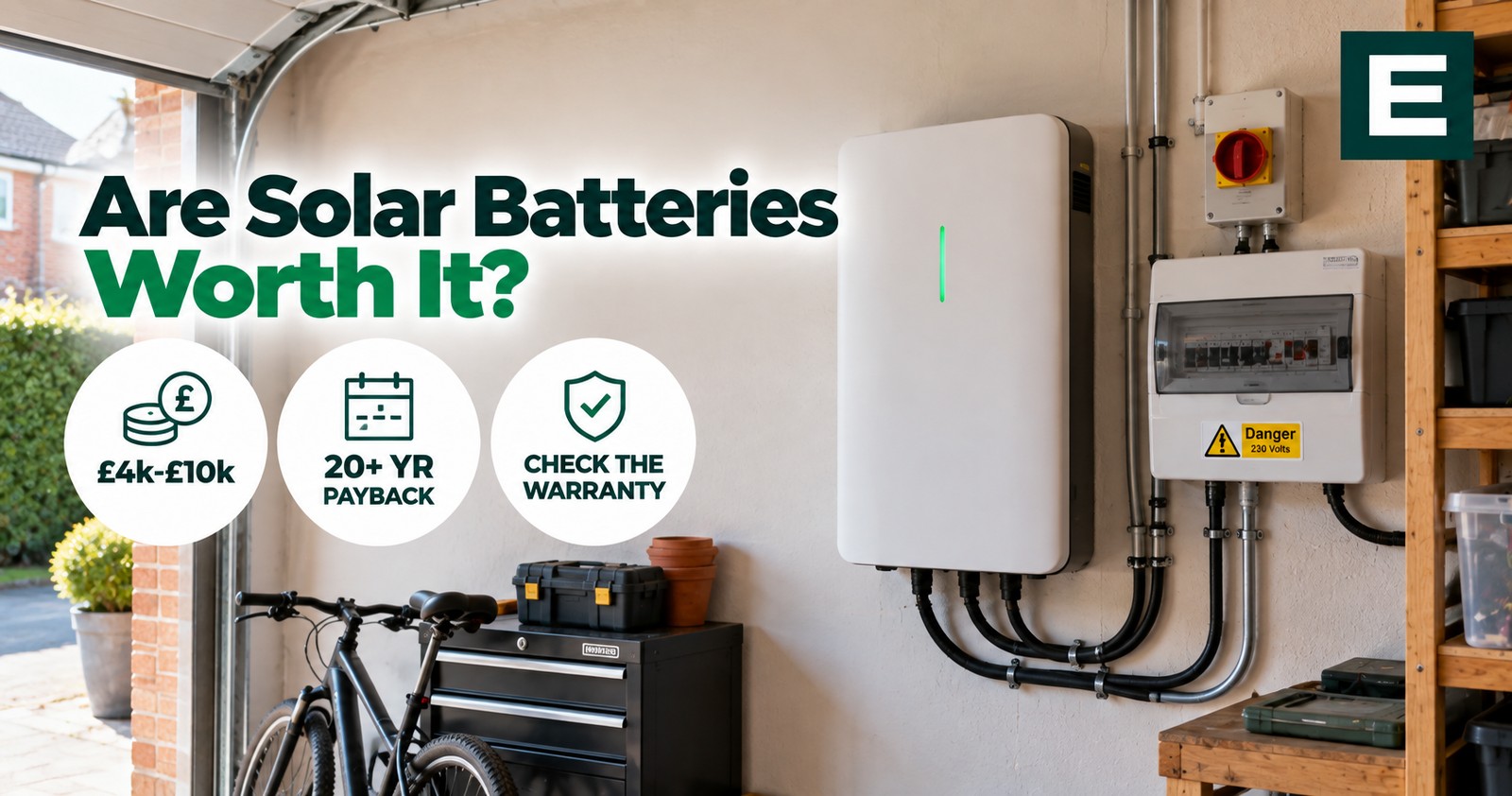
A home battery costs between about £4,000 and £10,000 installed, which on many quotes is as much as the solar panels themselves. On a standard electricity tariff, storing your own solar generation, the payback is usually longer than the warranty.
Batteries that do pay back are generally doing something else, and understanding what changes the decision entirely.
The finding that surprised us
A battery earns its keep by letting you use electricity you would otherwise have exported. So its value is the gap between what you pay to import and what you are paid to export.
Which produces a result nobody seems to mention: the better your export rate, the worse the case for a battery.
Take a 10 kWh battery at £6,500 installed on a 4kWp system, shifting 1,360 kWh a year from export to self-use. Import at 26.32p under the current price cap.
| Your export rate | Value of each kWh shifted | Annual saving | Payback |
|---|---|---|---|
| 4p | 22.3p | £304 | 21 years |
| 8p | 18.3p | £249 | 26 years |
| 16p | 10.3p | £140 | 46 years |
Our calculation. Import price from the Ofgem price cap for 1 October to 31 December 2026.
Every figure in that table is longer than any warranty on the market. Batteries are typically warranted for ten to twelve years.
So if you have negotiated yourself onto a good export tariff, as we recommend on our export rates page, you have simultaneously weakened the argument for a battery. The two decisions pull against each other, and no quote will tell you that.
So why do batteries pay back for some people?
Because they are not being used to store solar. They are being used to trade electricity.
On a time-of-use tariff you can import at perhaps 7p to 8p overnight and avoid paying 26.32p at peak. That gap is around 18p per kWh, every day, regardless of whether the sun shone.
A 10 kWh battery cycled daily on that basis shifts around 3,650 kWh a year, which is worth roughly £650. That gives a payback nearer ten years, and it is where the “five to seven year payback” figures you will see come from.
Now the part that follows from it, and which we have not seen stated anywhere:
If your battery pays back through tariff arbitrage, the solar panels are almost incidental. That battery would pay back at much the same rate with no panels at all. You are not buying a solar accessory. You are buying a device that exploits the difference between overnight and peak electricity prices.
That is a perfectly reasonable thing to buy. But it should be evaluated on its own terms, against its own payback, rather than folded into a solar quote as though the panels made it work.
Two conditions attach to it. You have to be willing to move onto a time-of-use tariff and stay engaged with it. And the arbitrage gap has to persist, which depends on tariff design that suppliers can change.
What a battery actually costs
There is no equivalent of the DESNZ cost dataset for batteries, so unlike our solar cost figures these come from commercial sources and the spread between them is wide.
| Capacity | Installed cost, typical range quoted |
|---|---|
| 5 kWh | £2,500 to £5,500 |
| 10 kWh | £4,000 to £9,500 |
| 13.5 kWh | £7,400 to £11,500 |
Ranges drawn from a review of commercial battery guides published in 2026. The spread reflects genuine variation in brand, specification and installation, and also disagreement between sources.
Two things to note. Retrofitting to an existing solar system typically adds several hundred pounds for additional inverter work and a further grid notification. And 0% VAT applies until 31 March 2027, after which the rate is expected to return to 5%.
A warranty is only as good as the company behind it
This is not a hypothetical concern, and 2026 has just demonstrated it.
GivEnergy Ltd, company number 11571089, entered administration on 9 April 2026 and is listed at Companies House with a status of In Administration. It was one of the best known names in UK home batteries, and its twelve year warranty was routinely cited as a reason to choose it.
Existing systems reportedly continue to function. But a manufacturer warranty from a company in administration is worth considerably less than the paper it is written on, and we have seen guides published this year still recommending the hardware on the strength of that warranty.
The practical lessons generalise beyond one company:
- Check the manufacturer at Companies House before you buy. It is free, it takes two minutes, and it is not something any installer will suggest.
- Your contract is with your installer, not the manufacturer. If hardware fails, your first recourse is the company that sold and fitted it. That makes the installer’s own financial stability part of the decision too.
- A longer warranty from a weaker company is worth less than a shorter one from a stronger company. Warranty length is the headline; who stands behind it is the substance.
We are not naming a recommended brand. We have no way to assess build quality independently, and a recommendation we could not stand up would be worth nothing.
What to check before you agree to one
Is the payback calculation based on solar or on tariff arbitrage? Ask directly. If the figures assume a time-of-use tariff, ask what the payback is without one.
What is the warranty, in years and in cycles? Most are ten to twelve years and six thousand to ten thousand cycles, whichever comes first. At one cycle a day, six thousand cycles is about sixteen years, so the year limit usually binds.
What capacity is retained at the end of the warranty? Typically seventy to eighty per cent. A battery at the end of its warranted life is not the battery you bought.
Does it provide backup power in a cut? Frequently assumed and frequently not included. Where it is available it often requires extra hardware and wiring at additional cost. Get it in writing.
Where is it going? A frost-free indoor location is preferable. Outdoor installation is possible but cold weather reduces efficiency.
How is it sized? Sizing should follow your evening electricity use, not your panel capacity. A battery larger than your evening demand spends part of its life doing nothing.
When a battery does make sense
Being fair to the case, because there is one.
- You are willing to run a time-of-use tariff and engage with it. This is the main one, and it is a lifestyle question as much as a financial one.
- You are out all day, so your solar self-consumption is low and there is a large surplus to capture.
- You have an electric car and can co-ordinate charging with cheap overnight rates.
- You want backup power and value resilience for its own sake rather than as an investment. That is a legitimate reason to spend money and it does not need to pay back.
And when it does not:
- You are at home during the day and already using most of what you generate. There is less surplus for the battery to capture, and it is competing with your own consumption.
- You have a good export tariff. Counterintuitive, but the table at the top of this page shows why.
- You want to stay on a standard tariff. The arbitrage case disappears and you are left with the solar-storage case, which is weak.
- The quote bundles it without discussion. Not a reason in itself, but a reason to ask harder questions.
What our figures leave out
Working against the battery: our calculation ignores round trip losses, since a battery returns less than it stores, and it assumes the battery is available to cycle whenever there is surplus, which is optimistic in winter.
Working for it: electricity prices will probably rise, which widens the import to export gap and improves the case. And we have used a single midpoint cost, when the cheaper end of the market would shorten payback considerably.
What we have not done is assume a time-of-use tariff in the main table, because that would be measuring a different thing. The table answers one question: what is a battery worth for storing your own solar on an ordinary tariff? The answer is, less than the industry implies.
Frequently asked questions
These come up most often when a battery appears on a solar quote.
Is a solar battery worth it in the UK?
On a standard tariff, storing only your own solar, usually not: our figures put payback at twenty years or more, which is longer than the warranty. On a time-of-use tariff where you can charge cheaply overnight and avoid peak prices, the case is much stronger, at around ten years.
How much does a home battery cost?
Roughly £2,500 to £5,500 for 5 kWh, £4,000 to £9,500 for 10 kWh and £7,400 to £11,500 for 13.5 kWh installed. There is no official dataset for battery prices, so these ranges come from commercial sources and vary widely.
Does a better export rate make a battery more worthwhile?
No, the opposite. A battery’s value is the gap between your import and export prices. A high export rate narrows that gap and lengthens the payback.
Do I need solar panels to have a battery?
No. A battery on a time-of-use tariff pays back through the difference between overnight and peak electricity prices, which works with or without panels. If that is the basis of your quote, the panels are not what makes the battery worthwhile.
Is there a grant for solar batteries?
No. The Boiler Upgrade Scheme is for heat pumps only and there is no battery equivalent. 0% VAT applies until 31 March 2027. Scotland’s Home Energy Scotland Grant and Loan can cover battery storage for eligible households.
Will a battery keep my lights on in a power cut?
Only if it has backup capability, and many do not include it as standard. Where available it often needs extra hardware and wiring. Confirm it in writing before signing.
Last updated 15 September 2026. Battery costs are drawn from a review of commercial guides published in 2026; there is no official UK dataset for home battery prices, unlike solar installation costs. Import electricity prices from the Ofgem price cap for 1 October to 31 December 2026. All payback figures are our own calculations, with assumptions stated, and exclude round trip losses and electricity price inflation. GivEnergy Ltd company status verified against the Companies House register, company number 11571089, on 15 September 2026; the register records administration as having started on 9 April 2026. Written by Ben Jardine.