
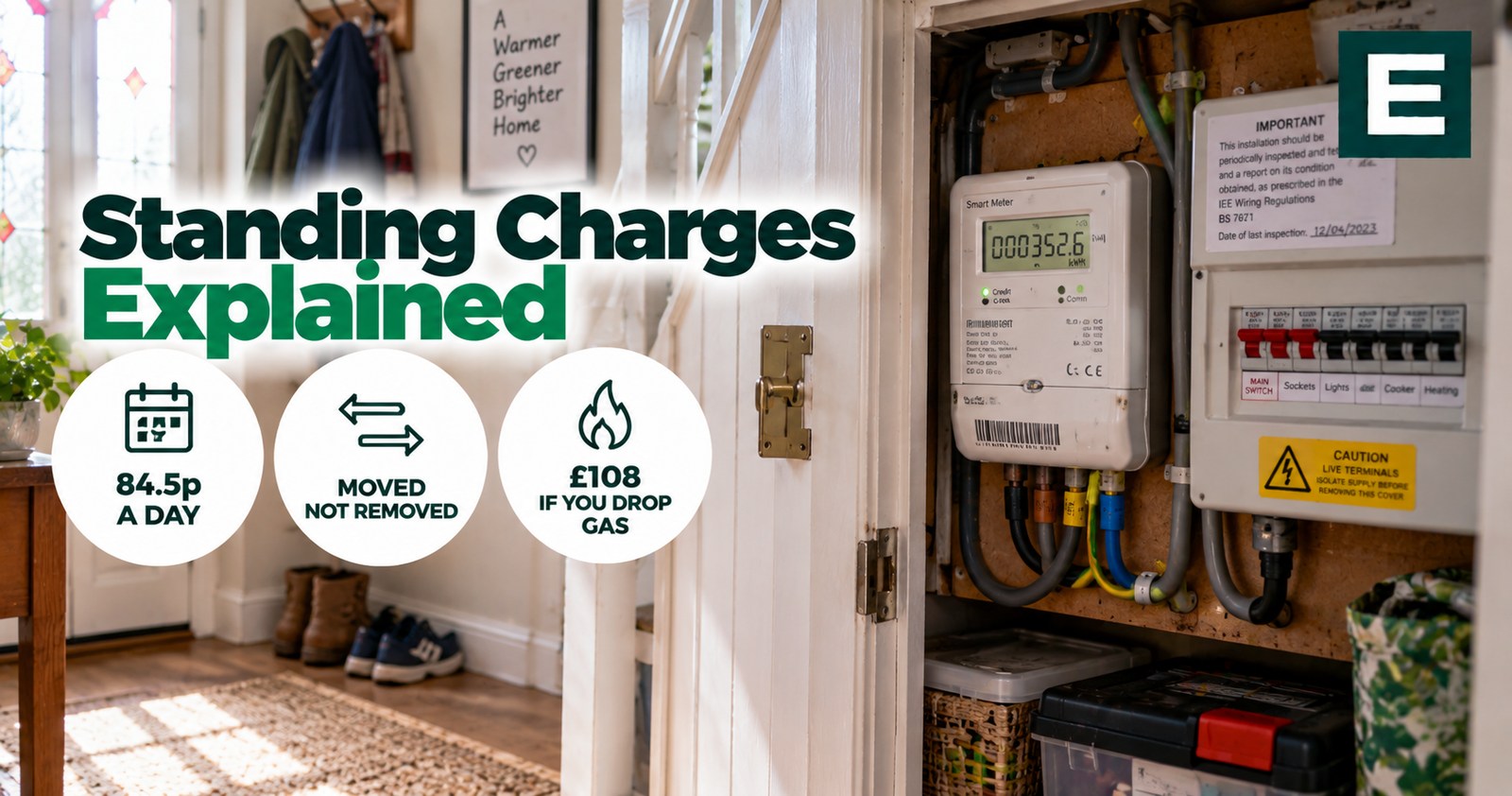
A standing charge is a fixed daily amount you pay for gas and electricity whether you use any or not. Under the current price cap that is around 84.5p a day for a dual fuel household, or roughly £308 a year, before a single kettle has boiled.
It is the most complained-about part of an energy bill and the least explained. Here is the part most people are not told: the costs it covers cannot be removed, only moved. Ofgem says so itself. Which means every proposal to cut standing charges is really a proposal to put those costs somewhere else, and whether that helps you depends entirely on how much energy you use.
What you are actually paying for
Under the Ofgem price cap for 1 October to 31 December 2026, the standing charges are:
| Fuel | Per day | Per year |
|---|---|---|
| Electricity | 54.83p | around £200 |
| Gas | 29.7p | around £108 |
| Both | 84.5p | around £308 |
England, Scotland and Wales average for direct debit customers. Standing charges vary by region because the cost of maintaining local networks varies.
The House of Commons Library breaks the electricity standing charge down like this:
- Just over 60% is network costs. Around 22.3p a day goes to the national high voltage transmission system and 11.6p a day to your regional distribution network. These are the wires, pylons and substations that get electricity from power stations to your house.
- Just over a quarter is supplier operating costs and industry charges, including the cost of the smart meter rollout.
- The remainder covers other allowances, including the cost of supplier failures, which fell on everyone after the wave of company collapses in 2021 and 2022.
None of that varies with how much you use. The wires cost the same to maintain whether you boil one kettle a day or run a heat pump.
Why electricity costs nearly twice what gas does
Gas standing charges contain no network charges at all. Gas network costs are recovered through the unit rate instead.
That is a policy choice about where to put the cost, not a difference in what the networks cost to run. It is also why the electricity standing charge is so much more visible and so much more resented.
Why it went up
The transmission element of the electricity standing charge rose by 65% in the second quarter of 2026, almost 9p a day. That increase funds a large expansion in investment by the National Energy System Operator in the high voltage transmission network, much of it to connect new renewable generation.
So a portion of the standing charge is now, in effect, paying for the grid of the 2030s. Whether that should be recovered from every household equally, or through unit rates, or through general taxation, is exactly the argument Ofgem is currently having.
One small counter-movement. In October 2026 the electricity standing charge fell by 2.4p a day, because VAT was removed from household electricity until March 2027. The gas standing charge rose by 0.7p over the same period.
Why it feels unfair, and why it partly is
A fixed charge falls hardest on households that use least. Someone living alone in a small flat pays the same daily standing charge as a family of five in a detached house with an electric car.
As a share of the bill, that makes the standing charge regressive. For a low user it can be a third or more of what they pay. For a high user it is a small fraction. That is the heart of the complaint, and it is a fair one.
The counter-argument is also fair: the network has to be there for everyone, and a household that uses little still benefits from having it available the moment they switch something on. There is no answer that suits both groups, which is why this has been under review for years.
Lower standing charge tariffs, and the catch
Ofgem has been working on tariffs that let households pay less in standing charge in exchange for a higher unit rate. The current position is a one year pilot, starting in June 2026, in which participating suppliers offer a lower standing charge tariff to eligible customers.
You may read that every supplier is already required to offer one. That was proposed in 2025, but Ofgem’s own policy page describes the current arrangement as a pilot. Check with your supplier rather than assuming.
The important part is what Ofgem says about these tariffs itself. It is clear that it cannot remove the costs that make up the standing charge, only move them from one part of the bill to another, and that the change is unlikely to reduce bills because a lower standing charge comes with a higher unit rate.
So a lower standing charge tariff is not a discount. It is a different shape of bill, and like a time of use tariff, it is a bet on your own consumption.
Will a lower standing charge save you money?
There is a simple way to work it out, and it works for any tariff a supplier offers you.
Break-even usage = the annual standing charge saving, divided by the increase in unit rate.
An illustration. Suppose a tariff cuts the electricity standing charge by 44.83p a day, to 10p, and raises the unit rate by 6p. The annual saving on the standing charge is £163.63. Divide that by 6p and you get roughly 2,700 kWh.
- Use less than 2,700 kWh a year: the tariff saves you money.
- Use more: it costs you money, and the more you use, the more it costs.
Those figures are illustrative rather than quoted from any supplier. Do the same sum with the actual rates you are offered and your own annual usage, which is on your bill.
The break-even tends to land near typical consumption by design: a supplier sets the unit rate so it recovers the same money from an average customer. Below average you win. Above average you lose.
Who should not touch one
This is where standing charges connect to everything else on this site.
Heat pump households. A heat pump can add 3,000 to 4,000 kWh a year to your electricity use, putting you well above any break-even. A lower standing charge tariff would raise the price of every unit your heat pump uses. It is almost exactly the wrong tariff.
Electric car owners. A car doing 8,000 miles adds around 2,300 kWh. Same problem, and you would also be giving up the overnight rates that make a time of use tariff worthwhile.
Anyone with high daytime use, including large households and anyone working from home in winter.
The people who genuinely benefit are low users: single occupants, small flats, and second homes that sit empty much of the year.
The only way to actually get rid of one
You cannot opt out of a standing charge while you have the supply. You can, however, remove the supply.
Disconnecting your gas entirely saves around £108 a year in gas standing charges. That only makes sense if you are no longer using gas for anything, which in practice means you have moved to a heat pump and an electric hob.
It is a real saving and it is almost always left out of heat pump payback calculations. We include it in whether a heat pump is worth it. Note that simply not using gas while keeping the meter connected saves nothing: the standing charge continues until the supply is capped.
A caution before doing it. Your gas network operator will charge to disconnect and cap the supply, and reconnecting later is expensive and slow. It is a decision for when a heat pump is installed and working well, not before.
What else affects your standing charge
Where you live. Standing charges vary by region because distribution network costs vary. Rural and remote areas typically cost more to serve.
How you pay. Direct debit, standard credit and prepayment can carry different rates.
Your tariff. Fixed tariffs set their own standing charges, which may be higher or lower than the cap. When comparing tariffs, compare the standing charge as well as the unit rate. A cheap unit rate with a high standing charge can cost a low user more than the headline suggests.
For how the standing charge sits within the wider cap, see our guide to the energy price cap.
Frequently asked questions
These come up most often about standing charges.
What is a standing charge?
A fixed daily amount on your gas and electricity bills that you pay regardless of how much you use. It covers network costs, supplier operating costs and industry charges. Under the current price cap it is around 84.5p a day for dual fuel.
Can I avoid paying a standing charge?
Not while you have the supply connected. The only way to stop paying one is to disconnect that supply entirely. Removing a gas supply saves around £108 a year, but only makes sense if you no longer use gas for anything.
Why is my electricity standing charge higher than gas?
Because electricity standing charges include network costs, which make up just over 60% of them, while gas standing charges contain no network charges at all. Gas network costs are recovered through the unit rate instead.
Will a lower standing charge tariff save me money?
Only if you use less than the break-even amount. A lower standing charge comes with a higher unit rate, and Ofgem has said the change is unlikely to reduce bills. Divide the annual standing charge saving by the unit rate increase to find your break-even.
Should I switch to a low standing charge tariff if I have a heat pump?
Almost certainly not. A heat pump adds thousands of kWh a year, which puts you well above any break-even, so a higher unit rate would cost you more than the lower standing charge saves.
Why did standing charges go up?
The largest recent rise was the transmission element of the electricity standing charge, up 65% in the second quarter of 2026, to fund investment in the national grid by the National Energy System Operator.
Last updated 20 September 2026. Standing charge levels from the Ofgem price cap for 1 October to 31 December 2026, England, Scotland and Wales average for direct debit customers. Composition of the electricity standing charge and the transmission increase from the House of Commons Library research briefing on energy standing charges. Lower standing charge tariff position from Ofgem’s published policy updates; note that some sources describe a mandatory requirement that Ofgem’s own page describes as a pilot. The break-even example uses illustrative rather than quoted tariff figures. Written by Ben Jardine.