
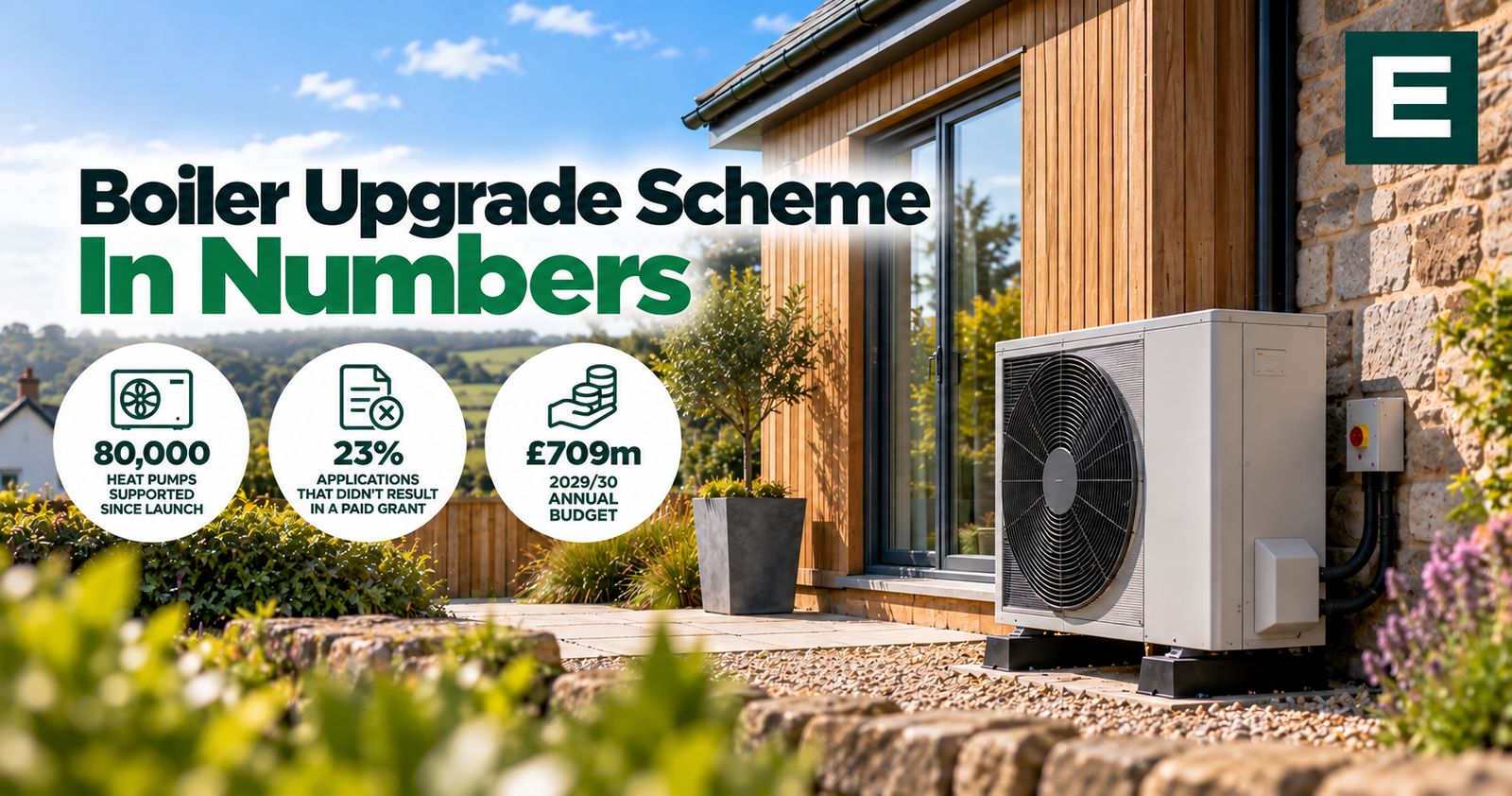
The Boiler Upgrade Scheme (BUS) is the government’s main grant for switching from a gas, oil or LPG boiler to a heat pump. The headline numbers, that the scheme has now paid grants on more than 93,000 installations, get repeated everywhere. What gets left out is what happens to the applications that don’t make it through: the rejections, the withdrawals and the vouchers that expire before the work is done. This report pulls that together in one place, with the sources you can check yourself.
- BUS has paid grants on 93,364 installations since applications opened on 23 May 2022, 98% of them air source heat pumps.
- July and August 2026 were the two busiest months in the scheme’s history, with 8,150 and 7,486 applications, following the arrival of the £9,000 grant for off-grid homes on 21 July.
- In Scheme Year 4 (2025/26), 13% of applications were rejected or withdrawn before a voucher was issued, and about one in six vouchers issued expired before the work was done. Most expired vouchers come back: 74% of those that expired in 2024/25 have since been reapplied for and paid.
- Growth over the full year has slowed: 2025/26 installations rose 24% year on year, down from previous years’ growth rates, and well short of the pace needed to hit the government’s 2030 target.
- In the scheme’s first year, around 60% of the available budget went unspent and was returned to the Treasury.
- The typical installation is getting smaller: the share of air source installs of 12kW or more has fallen from around 35% to 18% since launch.
How many heat pumps has BUS actually funded?
Since applications opened on 23 May 2022, the scheme has paid grants on 93,364 installations across England and Wales to the end of August 2026, with 98% of those being air source heat pumps rather than ground source or biomass. Growth has not been steady. The scheme paid grants on 30,590 air source heat pumps in the 2025/26 financial year, up from 24,649 the year before, a 24% increase. That sounds healthy in isolation, but it is a slower growth rate than in previous years, and it falls well short of what’s needed. To reach the government’s target of 450,000 heat pump installations a year by 2030, BUS alone would need to support around 150,000 installations annually. On our own projection, if growth continued at 24% a year, the scheme would reach roughly 72,000 installations in 2029/30, under half of that figure. The surge in July and August 2026, covered below, is the first sign of a faster pace, but two months do not yet make a trend.
What do the latest monthly figures show?
July and August 2026 were the two busiest months since the scheme opened. July’s 8,150 voucher applications set a record, and August’s 7,486 was the second highest monthly total, 120% up on August 2025 (3,401). The jump followed the introduction of the £9,000 grant for off-grid homes replacing oil or LPG heating on 21 July. Across July and August, 5,351 applications were for the higher grant, 34% of the 15,636 received in those two months.
| Month | Voucher applications | Vouchers issued | Redemptions paid |
|---|---|---|---|
| May 2026 | 4,411 | 3,220 | 2,232 |
| June 2026 | 4,512 | 3,583 | 2,411 |
| July 2026 | 8,150 | 4,203 | 2,862 |
| August 2026 | 7,486 | 5,903 | 3,260 |
The rest of the pipeline is now catching up. August set monthly records for vouchers issued (5,903), redemption applications (3,329) and redemptions paid (3,260). An application can take several months to become a paid grant, so the summer surge will feed through to completed installations over the autumn. DESNZ revises monthly application figures in each release as applications are cancelled, resubmitted or rejected, so the most recent months may change slightly.
What happens to applications that don’t convert into an installation?
This is the part of the scheme that gets the least coverage. Ofgem’s annual report for Scheme Year 4 (April 2025 to March 2026), published on 31 July 2026, shows:
| Stage | Number | Share of applications |
|---|---|---|
| Applications received | 45,880 | 100% |
| Rejected (failed eligibility checks) | 2,645 | 5.8% |
| Withdrawn by applicant | 3,301 | 7.2% |
| Vouchers issued | 39,435 | 86.0% |
| Vouchers expired before redemption | 6,352 | 13.8% |
| Grants paid | 31,104 | 67.8% |
The stages don’t reconcile exactly within a single year, because some vouchers issued and grants paid in 2025/26 came from applications made the year before, and the applications total can include more than one application for the same property. Read with that in mind, around 13% of applications were rejected or withdrawn before a voucher was issued, slightly fewer than the 13.7% in 2024/25. According to Ofgem, applications were most often rejected because the installer or property owner did not supply further information when asked, or because the property was ineligible, for example where the heat pump had been commissioned more than 120 days before the application was made.
Expiry has risen. About one in six vouchers issued in 2025/26 (16.1%) expired before being redeemed, up from 11.0% the year before. An air source heat pump voucher lasts three months, and expiry usually reflects delay rather than a household giving up: Ofgem found that 45.5% of the vouchers that expired in 2025/26 had already been reapplied for and paid, and 74.2% of those that expired in 2024/25 have now been paid. That is why simply adding expired vouchers to rejections and withdrawals overstates how many homes miss out. Since 28 April 2026, installers can also apply without a valid EPC, one of several rule changes covered in our guide to the Boiler Upgrade Scheme, so future years may look different again.
Is the scheme spending its own budget?
In the scheme’s first year (2022/23), only around £60.3 million of the £150 million budget was issued as vouchers by the year end, meaning close to 60% of that year’s funding went unspent and was returned to the Treasury. The picture has since reversed. DESNZ’s own published business case sets out a rising four-year budget profile:
| Financial year | Annual grant budget |
|---|---|
| 2025/26 | £295 million |
| 2026/27 | £400 million |
| 2027/28 | £600 million |
| 2028/29 | £683 million |
| 2029/30 | £709 million |
That commits £2,392 million across the four years from 2026/27, on top of the £295 million agreed separately for 2025/26. Whether that larger pot gets fully used will depend on whether installer capacity and public awareness, both flagged as constraints in earlier years, keep pace with the funding. The budget was £150 million a year from 2022/23 to 2024/25, and in 2024/25 it was fully used, with a further £39 million drawn from departmental capital underspend to meet demand, taking grants paid that year to around £189 million. Underspend is no longer the safe assumption it was in year one.
Where is the money going, and is the typical installation changing?
The median cost of an air source heat pump installation, including the grant value, was £13,021 in 2025/26, up 4.2% on £12,498 the year before and close to the £12,995 recorded in 2022/23. Those are cash figures. Adjusted for inflation the trend is downward: the median for April to June 2026 was £12,908, which DESNZ calculates is 11% lower in real terms than the same quarter of 2023 (£14,545). It’s a figure worth reading alongside our own breakdown of heat pump installation costs. The type of installation is also shifting. In 2022/23, around 35% of air source installations were 12kW or larger, many replacing oil boilers in larger rural homes. By 2025/26 that share had fallen to 18%, and 81% of installations were between 4kW and 12kW. Grants paid since launch are now split almost evenly between urban and rural areas, 51% to 49%. Most went to homes that previously had gas heating: 55% of installations replaced a gas system, and 62% of properties were on the gas grid.
Related reading: our full guide to the Boiler Upgrade Scheme covers eligibility, the disqualifiers and how the money reaches you, our regional breakdown covers where the grants have actually gone and what the installer register shows about local coverage, and our grants hub covers every other UK home energy grant currently open.
Frequently asked questions
These are the questions we’re asked most often about how the Boiler Upgrade Scheme is performing.
How many Boiler Upgrade Scheme applications get rejected?
In Scheme Year 4 (2025/26), 5.8% of applications were formally rejected for failing eligibility checks, down from 6.0% the year before, and a further 7.2% were withdrawn by the applicant. About one in six vouchers issued (16.1%) expired before being redeemed, although most expired vouchers are later reapplied for and paid.
Is the Boiler Upgrade Scheme on track to meet government targets?
Not currently. On our own projection, if growth continued at the 2025/26 rate of 24% a year, the scheme would reach around 72,000 installations a year by 2029/30, well short of the roughly 150,000 a year needed from BUS to help meet the government’s target of 450,000 heat pump installations annually by 2030. Record applications in July and August 2026 suggest the pace may be picking up.
How much has the Boiler Upgrade Scheme budget grown?
The annual budget was £150 million a year from 2022/23 to 2024/25, rising to £295 million in 2025/26. DESNZ’s own business case sets it at £400 million for 2026/27, rising to £600 million in 2027/28, £683 million in 2028/29 and £709 million in 2029/30.
- DESNZ, Boiler Upgrade Scheme statistics: August 2026, published 24 September 2026, Tables 1.1, 1.3, 1.5, 1.6, M1.1, Q1.1B and A1.3A. All monthly releases are in the Boiler Upgrade Scheme statistics collection
- Ofgem, Boiler Upgrade Scheme Annual Report, April 2025 to March 2026 (Scheme Year 4), published 31 July 2026
- Ofgem, Boiler Upgrade Scheme Annual Report, April 2024 to March 2025 (Scheme Year 3)
- DESNZ, Boiler Upgrade Scheme 2026 to 2030: Summary Business Case, Table 5
- Nesta, “Four years of the Boiler Upgrade Scheme in four charts”, 30 April 2026, based on DESNZ statistics