
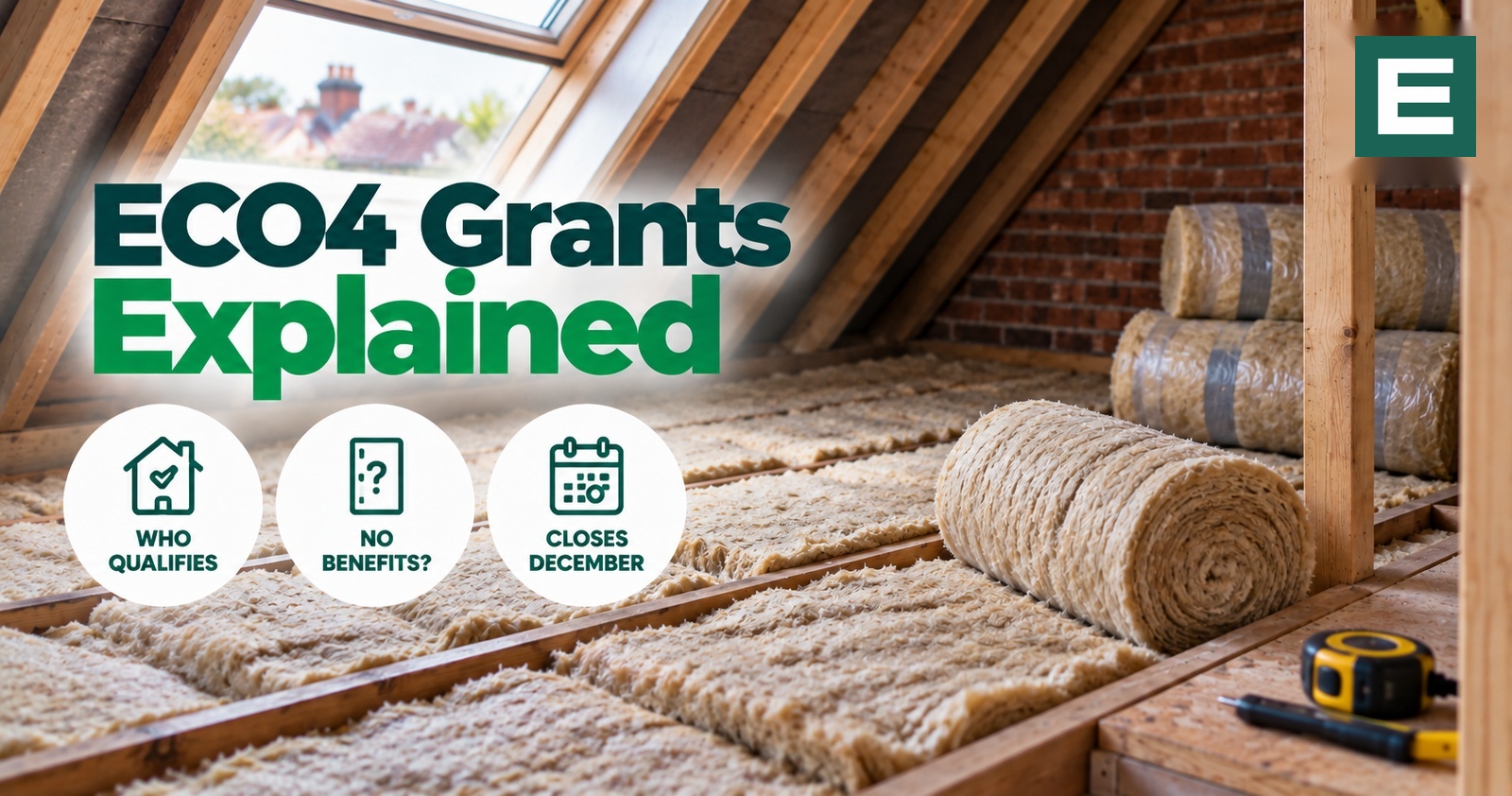
ECO4 closes on 31 December 2026
The Energy Company Obligation is the scheme that pays for insulation, heating and other efficiency work in the least efficient homes, at no cost to qualifying households. Its fourth phase, ECO4, was originally due to end on 31 March 2026. The government confirmed a nine-month extension in January 2026, so it now runs to 31 December 2026.
That extension matters, because a good deal of what you will find online still says the scheme closed in March. It did not. But it is closing, there will be no ECO5, and if you qualify the window is genuinely short.
This page covers who qualifies, including the route most people have never heard of, what the scheme pays for, when you actually need to apply by, and what replaces it.
The real deadline is not 31 December
Two things make the practical cut-off considerably earlier than the official one.
The process takes months, not weeks. A typical ECO4 job runs from initial contact through eligibility checks, a survey, a retrofit assessment and scheduling before anything is installed. Industry estimates put this at roughly ten to eighteen weeks. Working backwards from 31 December, an application starting now is already close to the edge, and one starting in November almost certainly will not complete.
The funding is an obligation, not a pot. This is the part that catches people out, and it is worth understanding properly. ECO is not a government fund that sits there until the closing date. It is a legal obligation placed on large energy suppliers to deliver a fixed amount of work. Once a supplier has met its obligation, it has no reason to keep funding installations, and delivery through that supplier stops. In the final months of any ECO phase, availability tightens well before the deadline arrives.
So the honest advice is that if you qualify, the time to act is now rather than in the autumn.
Route one: qualifying benefits
Most households come in through the benefits gateway. If you or someone living at the property receives one of the following, you have met the household side of the test:
- Universal Credit
- Pension Credit, Guarantee Credit or Savings Credit
- Income Support
- Income-based Jobseeker’s Allowance
- Income-related Employment and Support Allowance
- Child Tax Credit
- Working Tax Credit
- Housing Benefit
- Child Benefit, subject to an income threshold that varies by household composition
One thing to watch. The benefit needs to be current at the point of assessment. If an award ended shortly before the application, it will fail. Have a recent award letter to hand.
Route two: LA Flex, for households without benefits
This is the route most people do not know exists, and it is the reason a lot of households wrongly assume they are excluded.
Local Authority Flexible Eligibility, usually called LA Flex or ECO4 Flex, lets your council refer you for funding without any qualifying benefit at all. Ofgem sets four national routes and most participating councils enable all of them. The two that catch the majority of households are:
- Low household income. Gross income below £31,000 a year from all sources, regardless of household size or region.
- Health vulnerability to cold. Someone at the address has a condition made worse by living in a cold home, commonly respiratory, cardiovascular, or limited mobility conditions. Income is not the test here. Councils typically want supporting evidence such as a GP letter.
The other two routes cover referrals from NHS or local authority services for vulnerable households, and bespoke arrangements agreed between a council or supplier and central government.
Three practical points. Your council has to be participating, and not all are. Criteria and evidence requirements vary between councils, so a national guide can only take you so far. And social housing is excluded from LA Flex, though private rentals are eligible with the landlord’s consent.
The property test
Whichever route you come through, the property has to be inefficient enough to qualify. In practice that means an EPC rating of D, E, F or G, with homes rated E, F and G treated as higher priority. Homes already rated A, B or C do not qualify, on the basis that they are not the problem the scheme exists to solve.
If your EPC is several years old, it is worth checking. Ratings are property-specific and an out-of-date certificate sometimes shows a better rating than a current assessment would. You can look yours up free on the government’s Find an Energy Certificate service.
Both owner-occupiers and private tenants can qualify. Tenants need the landlord’s written consent, and landlords may be asked to contribute towards more expensive measures.
What ECO4 pays for
ECO4 takes a whole-house approach rather than funding single measures. The aim is to lift a property by at least two EPC bands where possible, which usually means a package of work rather than one job.
Commonly funded measures include:
- Loft insulation
- Cavity wall insulation
- Solid wall insulation, internal or external
- Underfloor and room-in-roof insulation
- First-time central heating
- Heating controls
- Heating system replacement, including heat pumps in some cases
- Solar panels, in some cases
For most eligible households the work is fully funded. In some cases a contribution is requested, depending on the measure and the circumstances.
What actually gets installed depends on a survey and a retrofit assessment of your property, not on what you ask for. A household hoping for solar may be told the sensible package is insulation and heating controls, because that is what the assessment supports.
How to apply, and what should never happen
There is no central application form and no government portal. ECO4 is delivered by installers working on behalf of energy suppliers, so the routes in are:
- Your local council, if you are going through LA Flex. Search your council’s website for “ECO4 Flex” or “flexible eligibility”
- Your energy supplier. You do not have to be a customer of the supplier funding the work, but starting with your own is straightforward
- An ECO-registered installer, who will check eligibility and handle the supplier side
Two things should never happen, and both are common enough to be worth stating plainly.
Nobody should charge you to apply. There is no application fee, no council fee, and no legitimate charge for submitting an LA Flex referral. Anyone asking for payment to process a government-backed grant application is not doing you a service.
Be wary of cold contact. ECO4 attracts a great deal of doorstep and telephone activity, some of it legitimate lead generation and some of it not. Approaching your council or a registered installer yourself puts you in a considerably better position than responding to someone who approached you.
Where the money actually comes from
ECO4 is routinely described as a government scheme, which is true in the sense that government created the obligation and Ofgem regulates it. It is not funded from taxation.
The cost sits with large energy suppliers, who recover it through everyone’s energy bills. The scheme is worth roughly £4 billion across its four-year run. That is worth knowing partly because it explains the supplier behaviour described above, and partly because it is simply how the thing works, whatever the marketing says.
What happens after December
There will be no ECO5. The supplier obligation model for domestic efficiency is ending, and government has moved to direct funding through the Warm Homes Plan published in January 2026.
The main successor for the households ECO4 serves is the Warm Homes: Local Grant, which is already running and delivered through local councils rather than energy suppliers. It runs to March 2028 and is aimed at lower-income households in homes rated EPC D to G. Because delivery is devolved to councils, what is on offer genuinely varies by area, which is unusual among UK energy schemes and means your own council’s website is the right starting point.
Two other schemes continue and are worth knowing about. The Boiler Upgrade Scheme runs to 2030, has no income test, and pays £7,500 towards a heat pump, though unlike ECO4 it does not cover the full cost. The Great British Insulation Scheme closed to new applications in January 2026 and has not been replaced as a standalone scheme.
The honest summary: if you qualify for ECO4 today, applying now is materially better than waiting for the successor. Warm Homes: Local Grant funding levels, eligibility and contractor capacity vary by council and are not a like-for-like replacement.
Frequently asked questions
These come up most often as the deadline approaches.
Has ECO4 already closed?
No. It was due to close on 31 March 2026 but was extended by nine months and now runs to 31 December 2026. Pages still saying it closed in March are out of date.
Can I qualify without being on benefits?
Yes, through LA Flex, if your council participates. The two most common routes are a gross household income under £31,000, or someone at the address having a health condition made worse by a cold home.
Is it really free?
For most eligible households, yes. In some cases a contribution towards more expensive measures is requested, and landlords in particular may be asked to contribute. Nobody should charge you to apply.
Can tenants apply?
Yes, with the landlord’s written consent. The tenant must be the occupier and must meet the eligibility criteria. Social housing is excluded from the LA Flex route.
Can I combine ECO4 with the Boiler Upgrade Scheme?
No. Work funded through ECO is explicitly excluded from Boiler Upgrade Scheme eligibility. You cannot take both towards the same installation.
What if my EPC says C?
You will not qualify on the property test. If your certificate is old, a current assessment may produce a different rating, so it is worth checking rather than assuming.
When do I realistically need to apply by?
As soon as possible. Allowing ten to eighteen weeks for the process, and given that supplier funding tightens once obligations are met, autumn is late rather than comfortable.
Last updated 13 September 2026. Scheme dates and eligibility routes verified against Ofgem and government guidance on ECO4 and flexible eligibility. LA Flex criteria and participation vary between councils, so confirm the position with your own local authority. Written by Ben Jardine.