
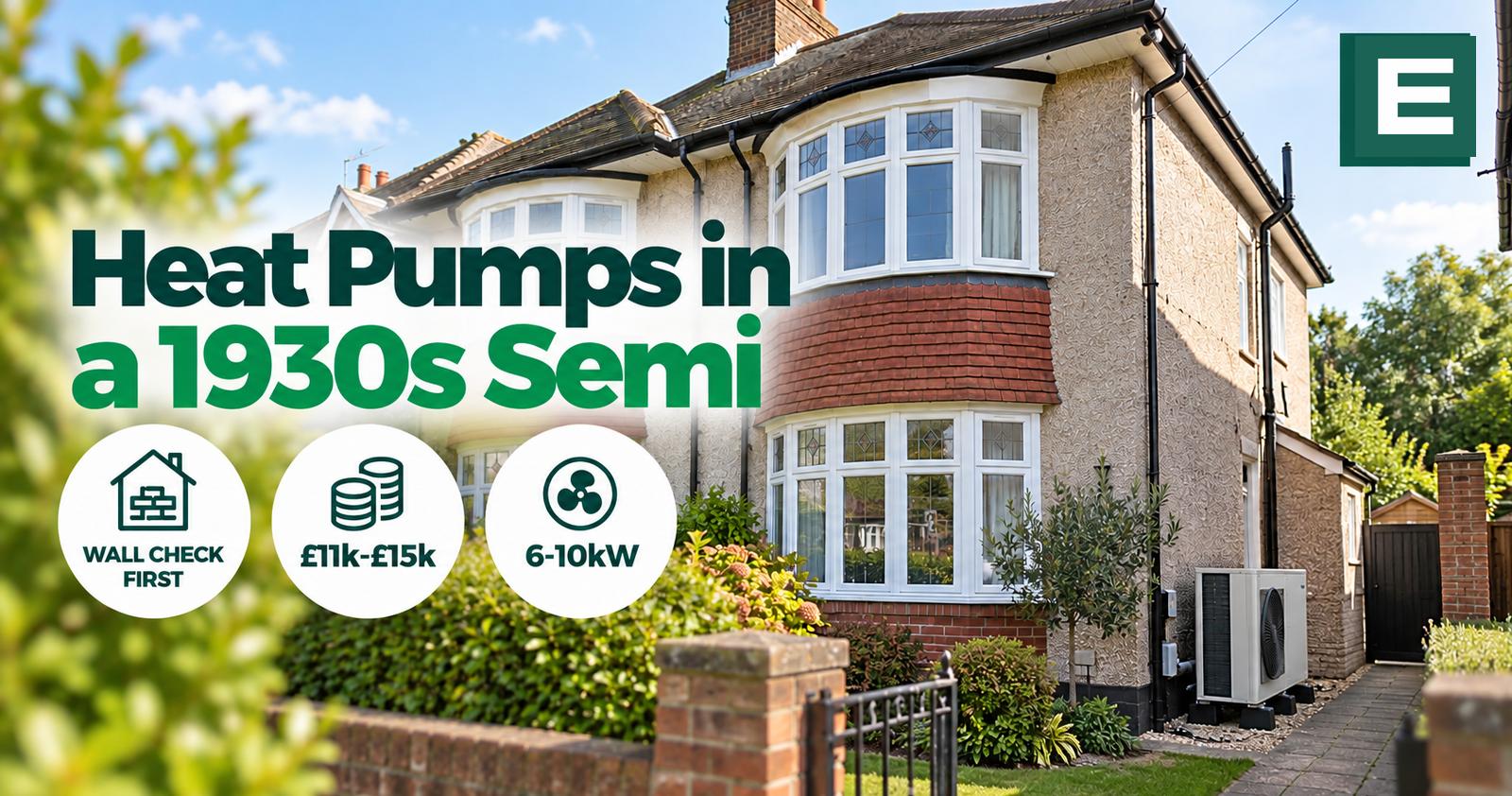
A heat pump in a typical 1930s semi costs £11,000 to £15,000 installed, which after the £7,500 Boiler Upgrade Scheme grant leaves most households paying £3,500 to £7,500. That is higher than the figure usually quoted for a three-bedroom house, and the reason is almost always the walls.
This page covers what makes this particular property type different, what the government’s own trial data says about how heat pumps actually perform in interwar homes, and the one check worth doing before you get a single quote.
The wall question, which almost everyone gets wrong
The standard advice is that 1930s semis have cavity walls, unlike Victorian terraces, and can therefore be insulated cheaply. That advice is right often enough to be dangerous.
The 1930s sits exactly on the transition between solid and cavity construction in British housebuilding. Cavity walls came into use in the 1920s and 1930s and did not become standard until the 1950s. So a house built in 1932 might have an early narrow cavity, or it might be solid nine-inch brick, and there is no way to tell from the outside, particularly where the front is pebbledashed or rendered, as so many are.
It gets worse. Construction is often not uniform across the same house. A solid bay on an otherwise cavity-built property is common, and a rebuilt rear wall or a later outshot may be different again.
Why this matters more than anything else on the page. If the walls are cavity and unfilled, filling them costs a few hundred pounds and transforms the heat loss calculation. If they are solid, improving them means internal or external wall insulation at a a five-figure job, which changes the entire economics of the project. Those two scenarios produce completely different answers to the question of whether a heat pump makes sense.
The only reliable check is a borescope inspection, where a small hole is drilled and a camera inspects the cavity. Any competent installer or insulation surveyor can do this, and it should happen before you accept a quote rather than after.
What the trial data actually says
Most claims about heat pumps in older properties are assertion. There is a real evidence base, and hardly anyone cites it.
The Electrification of Heat demonstration project, funded by what is now DESNZ and run by Energy Systems Catapult, installed and monitored 742 heat pumps across British homes. Semi-detached properties made up 43% of the sample, and 105 of the homes fell in the 1919 to 1944 age band, which is where your house sits. Homes ranged from EPC A down to G.
Three findings worth carrying into a conversation with an installer:
- No property type or era was found unsuitable. The project’s conclusion was that heat pumps can be installed successfully across all the property types tested, including interwar stock, when the system is designed and installed properly.
- Semi-detached homes performed slightly below detached ones. The monitoring found a statistically significant difference in seasonal efficiency between the two. It also found no significant difference between semi-detached and terraced homes, which suggests the gap is about heat loss and system design rather than anything inherent to the house type.
- The failures were design failures, not building failures. Where systems underperformed, the causes were oversizing, poor commissioning and high flow temperatures into undersized radiators. None of those are properties of a 1930s house. They are properties of a rushed installation.
That last point is the one to hold on to. The building is rarely the reason a heat pump disappoints. The survey usually is.
What it costs in this property
The most reliable cost figures come from the Boiler Upgrade Scheme itself, because every grant redemption records what was actually paid.
| Measure | Figure |
|---|---|
| Median air source install, all properties, 2025/26 | £13,021 |
| Middle half of all installs, April to June 2026 | £11,128 to £15,627 |
| Typical 1930s semi, our estimate | £11,000 to £15,000 |
| After the £7,500 grant | £3,500 to £7,500 |
Install costs from DESNZ Boiler Upgrade Scheme Statistics. The property-type estimate is ours, not an official figure.
A 1930s semi sits around the middle of that national range rather than at the bottom, which is where the commonly quoted £9,000 figure would put it. Three features of the building account for the difference.
Radiators
This is the largest variable item and the one most likely to be vague on a quote. Radiators sized for a boiler running at 70°C are usually too small for a heat pump running at 45°C or below. In a three-bedroom semi, expect four to six radiators to need changing at £150 to £400 each.
Interwar semis have a specific complication here. The bay window is a notorious cold spot where the bay roof meets the walls, and the radiator under it is frequently undersized for the heat loss in that room even by boiler standards.
Pipework
Microbore pipework, common in properties reheated in the 1970s and 1980s, restricts flow at the volumes a heat pump needs. Replacing it adds £1,000 to £3,000. Whether yours needs it depends on when the heating was last done, not on when the house was built.
The suspended timber floor
Almost every 1930s semi has floorboards over a ventilated void, almost always uninsulated, and it is the source of the cold draught at skirting level. It is not a heat pump cost as such, but it affects the heat loss calculation, and therefore the size of unit you are quoted for. Insulating it before the survey can mean a smaller and cheaper system.
Where the outdoor unit goes, and why the rules changed
If you looked into a heat pump before 2025 and were told the unit had to sit a metre from your boundary, the position has changed. This is the most out-of-date advice still circulating about semis and terraces.
The Town and Country Planning (General Permitted Development) (England) (Amendment) Order 2025, which came into force on 29 May 2025, relaxed the permitted development rules for air source heat pumps in England. The amendment order itself raises the outdoor unit size limit on a house from 0.6 to 1.5 cubic metres, and allows up to two units within the curtilage of a detached house where one would not meet the heat demand. Industry guidance, including from MCS, states that the same reform removed the requirement to site the unit at least one metre from the boundary, so a unit may now sit against a fence or wall provided the noise assessment passes.
For a 1930s semi that last point matters more than it does for most property types. A typical example is 6 to 7 metres wide with a side return, and under the old rule that side return frequently had nowhere compliant for a unit, which meant a planning application, a fee and months of delay.
One caution. The Planning Portal’s guidance page and a number of council websites still list the pre-2025 limits, including the one metre rule. Guidance has lagged the legislation here. If you are told your installation needs permission on boundary grounds, it is worth asking which version of the rules is being applied.
What still applies in every case: the installation must pass a sound assessment carried out by your installer under the MCS 020 standard, and since 28 May 2026 that standard is the only accepted basis. Listed buildings need consent, and properties in conservation areas or under an Article 4 direction sit outside permitted development altogether. A number of interwar suburbs now carry Article 4 directions, so check your council’s map rather than assuming.
Scotland, Wales and Northern Ireland did not follow England’s 2025 reform and retain their own rules, Wales with a wider boundary requirement than England ever had.
Running costs
The arithmetic here is the same as for any property, and it turns on one number.
Under the price cap for 1 October to 31 December 2026, electricity is around 26.32p per kWh and gas around 7.97p. A gas boiler at 85% efficiency delivers heat at about 9.4p per kWh. A heat pump needs a real-world seasonal efficiency of about 2.8 to match that.
A well-designed system in a reasonably insulated semi achieves 3.2 to 3.6, which beats gas. A poorly designed one in an uninsulated one can fall below 2.8, which does not. The building influences this, but the design decides it. We set out the full arithmetic in our guide to whether a heat pump is worth it.
If you are on mains gas with a working boiler, be realistic: the running cost saving in this property type is small, and may be nil. The case for a heat pump here is a replacement case, made when the boiler is near the end of its life.
When the answer is no
Three situations where we would say don’t, at least not yet.
Solid walls with no insulation plan. If the borescope finds solid brick and external wall insulation is out of budget, a heat pump will struggle and cost a great deal to run. Insulate first. Check whether the Warm Homes: Local Grant covers it in your council area.
A boiler with years left in it. Nothing is forcing your hand. The proposed 2035 phase-out of gas boilers in existing homes was dropped from the Warm Homes Plan in January 2026, and fitting a replacement gas boiler remains entirely legal.
An installer who quotes without a room-by-room heat loss calculation. In a property type where wall construction is genuinely uncertain, an estimate from floor area is worthless. Our guide to choosing an MCS installer covers what a proper survey involves.
The order to do things in
- Borescope the walls. Everything else depends on the answer.
- Fill the cavity if there is one. Cheapest measure available, biggest single effect on the heat loss calculation.
- Top up the loft to 270mm and insulate the suspended floor if budget allows.
- Then get heat pump quotes, so they are priced against the house you will have rather than the house you have now.
Doing it in this order can reduce the system size you need, which reduces the quote. Doing it the other way round means paying for capacity you then insulate away.
For the full cost breakdown across all property types, see our guide to what a heat pump actually costs, and for the grant itself, the Boiler Upgrade Scheme.
Frequently asked questions
These come up most often from owners of interwar semis.
Does a 1930s semi have cavity walls?
Possibly, but do not assume it. The 1930s is the transition decade between solid and cavity construction, and both are common. Render or pebbledash makes it impossible to tell by eye. A borescope inspection is the only reliable check.
Do I need to insulate before installing a heat pump?
Not as a scheme requirement. The Boiler Upgrade Scheme dropped its EPC and insulation conditions in April 2026. But insulating first usually reduces the system size you need, which reduces the price and improves running costs.
Will a heat pump work with my existing radiators?
Some of them, usually not all. Expect four to six to need upsizing in a typical three-bedroom semi. Any quote that says “radiator upgrades as required” without itemising them is not a quote you can compare.
What size heat pump does a 1930s semi need?
Typically 6 to 10kW, but that must come from a room-by-room heat loss calculation rather than a rule of thumb. An oversized unit cycles, runs inefficiently and costs more to buy.
Is a 1930s semi too old for a heat pump?
No. The government’s Electrification of Heat project monitored heat pumps across all property ages and found no era unsuitable, including the interwar band. Design quality matters far more than build date.
How much will I actually pay?
Most 1930s semis land between £11,000 and £15,000 before the grant, so £3,500 to £7,500 after it. Where you fall in that range depends mainly on wall construction, how many radiators need changing, and whether the pipework needs replacing.
Last updated 14 September 2026. Install costs verified against DESNZ Boiler Upgrade Scheme Statistics. Performance findings from the Electrification of Heat demonstration project, funded by DESNZ and delivered by Energy Systems Catapult. Energy prices from the Ofgem price cap for 1 October to 31 December 2026. Permitted development changes verified against the Town and Country Planning (General Permitted Development) (England) (Amendment) Order 2025 (SI 2025/560); note that Planning Portal guidance had not been updated to reflect these changes at the time of writing. Property-type cost estimates are our own and are flagged as such. Written by Ben Jardine.