
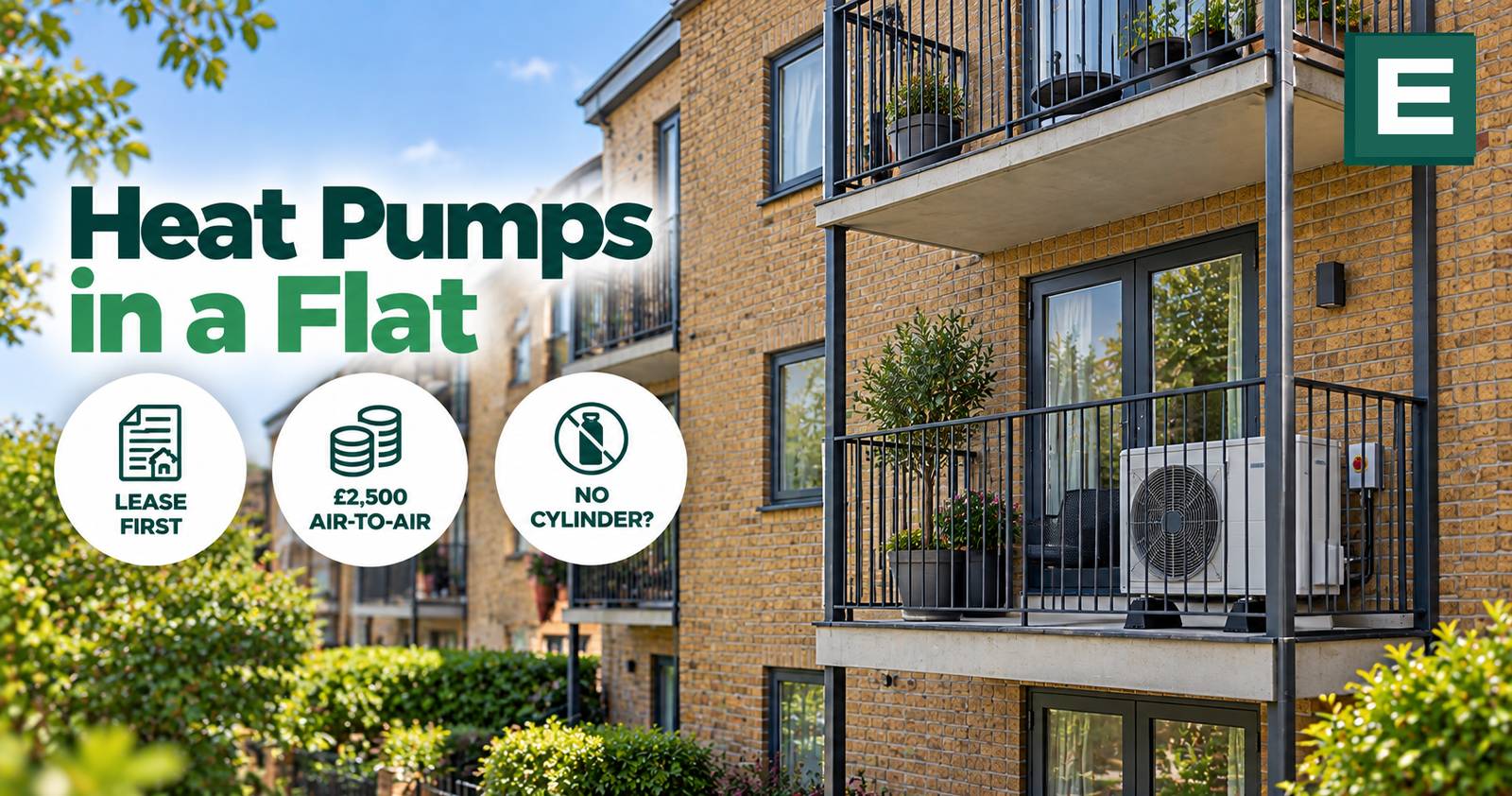
A flat is the hardest property type in the country to fit a heat pump into, and the obstacle is rarely technical. It is your lease.
That said, the answer changed in April 2026 in a way that most guides have not caught up with, and for a lot of flats it changed from no to maybe. This page sets out what is actually possible, what the freeholder has to agree to, and the two questions worth settling before you spend any money.
Start with the lease, not the heat pump
Almost every flat in England and Wales is leasehold, and almost every lease restricts alterations to the exterior of the building. An outdoor heat pump unit on a wall, a balcony or a roof is an exterior alteration.
So the sequence most people follow, get quotes then ask the freeholder, is the wrong way round. Your installer will need to satisfy themselves that you have consent before work starts, and no reputable one will proceed without it.
What to establish, in this order:
- Read the alterations clause in your lease. It will say whether external alterations are prohibited outright or permitted with consent.
- Identify who actually decides. The freeholder, the managing agent, or a residents’ management company. Where the block is share of freehold, it may be a vote of your neighbours.
- Ask what consent involves. Expect a formal licence to alter, a fee, and their solicitor’s costs charged to you. Commercial sources put the total in the region of £500 to £1,500 and the timeline at two to four months for a cooperative freeholder, longer for an institutional or absentee one. Those figures are indicative rather than official.
An unresponsive freeholder is the most common reason a flat installation never happens. It is worth finding that out in week one rather than after a survey.
The April 2026 change that most guides have missed
Until April 2026, the Boiler Upgrade Scheme funded air-to-water heat pumps, ground source and biomass. All of those heat water, which means all of them need a hot water cylinder. In a one or two bedroom flat there is frequently nowhere to put one, which ruled out a large share of the housing stock.
Since April 2026, air-to-air heat pumps are eligible at £2,500. An air-to-air system heats rooms directly through wall units rather than heating water, so it needs no cylinder at all.
That is the single most significant development for flats, and you will still find guides published this year stating that air-to-air does not qualify. It does. Check the date on anything you read.
The trade-off is real and worth stating plainly: an air-to-air system provides no hot water. You will need a separate solution, usually an electric immersion or a point-of-use heater, and that has running costs of its own. The grant is also £2,500 rather than £7,500.
The other change that helps is the removal of the EPC requirement in April 2026, which previously caught flats with outstanding insulation recommendations they had no power to act on.
Which system suits which flat
| System | Grant | Needs a cylinder | Best suited to |
|---|---|---|---|
| Air-to-water | £7,500 | Yes | Larger flats, maisonettes, ground floor with outside space |
| Air-to-air | £2,500 | No | Smaller flats, upper floors, no cylinder space |
| Shared ground loop | £7,500 per dwelling | Yes | Whole blocks, driven by the freeholder rather than you |
Grant values from Ofgem’s published scheme guidance.
The third row is worth knowing about even though you cannot instigate it alone. Where a block installs a shared ground loop system, each dwelling can attract the full grant. If your building is considering upgrading its communal heating, that is the conversation to get involved in.
Where the outdoor unit goes
Every air source system needs an outdoor unit somewhere. The realistic options in a flat:
- Ground floor with a garden or yard. Effectively a normal house installation. Easiest case by some distance.
- Balcony. Works, subject to the lease and to structural loading. Anti-vibration mounting matters more here than anywhere else, because the structure transmits it.
- External wall bracket. The usual answer for upper floors. Needs a structural assessment and is the option freeholders are most likely to refuse on appearance grounds.
- Communal roof or grounds. Rarely permitted for an individual leaseholder, because it is common parts rather than your demise.
Two rules apply regardless. The installation must pass a sound assessment under the MCS 020 standard, which in a block means the nearest neighbour’s window may be very close indeed. And permitted development treats flats less generously than houses: the 2025 amendment order raised the outdoor unit size limit to 1.5 cubic metres on a house, but the lower 0.6 cubic metre limit continues to apply to blocks of flats.
If your block has communal heating
This is where a lot of flats stop, and it is worth understanding why.
If your heating and hot water come from a communal boiler or a heat network rather than your own boiler inside the flat, you generally cannot claim the grant as an individual. The Boiler Upgrade Scheme replaces a property’s heating system, and in that arrangement the system is not yours to replace.
The route is for the building owner to upgrade the communal plant, which is a decision taken by the freeholder or the management company, usually through the service charge. If that is your situation, the useful action is not getting quotes. It is getting the item onto the agenda at the next residents’ meeting.
What it costs
Flats sit at the bottom of the national range because the systems are small.
| Measure | Figure |
|---|---|
| Median air source install, all properties, 2025/26 | £13,021 |
| Air-to-water in a flat, our estimate | £8,000 to £12,000 |
| After the £7,500 grant | £500 to £4,500 |
| Air-to-air in a flat, our estimate | £4,000 to £9,500 |
| After the £2,500 grant | £1,500 to £7,000 |
Median install cost from DESNZ Boiler Upgrade Scheme Statistics. Property-type estimates are ours, not official figures. Add freeholder consent costs on top.
The one figure people forget is the consent cost, which is money spent before you know whether the project can proceed at all.
When the answer is no
The freeholder refuses. There is usually no appeal, and no amount of enthusiasm for the technology changes it.
Communal heating you do not control. Covered above.
No viable outdoor unit position that passes the sound assessment. Common in dense blocks with windows on all sides.
You are renting. The applicant must own the property. A tenant cannot claim, though a landlord can.
Short lease. If you have under 80 years remaining and may sell or extend, spending several thousand pounds on a heating system is a decision worth taking alongside that, not separately.
The order to do things in
- Check whether your heating is yours or communal. If communal, stop here and talk to the management company instead.
- Read the alterations clause in your lease.
- Ask the freeholder what consent would involve, in writing, before spending anything.
- Work out whether you have cylinder space. That decides air-to-water against air-to-air, and therefore £7,500 against £2,500.
- Then get quotes from MCS-certified installers.
For the grant rules in full see the Boiler Upgrade Scheme, for the national cost picture see what a heat pump actually costs, and for the running cost arithmetic see whether a heat pump is worth it.
Frequently asked questions
These come up most often from flat owners and leaseholders.
Can you get a heat pump in a flat?
Yes, but it depends on three things: whether the flat has its own heating system rather than communal, whether there is a viable position for an outdoor unit, and whether the freeholder consents. The lease is usually the deciding factor rather than the building.
Do air-to-air heat pumps qualify for the grant?
Yes, at £2,500, since April 2026. A number of guides still say they do not, which was correct before that date. Air-to-air heats rooms but provides no hot water, so you will need a separate arrangement for that.
Do I need the freeholder’s permission?
Almost certainly, and in writing. Your installer will need to satisfy themselves that you have consent before proceeding, and your lease will almost certainly require it regardless. Expect a formal licence to alter, a fee and legal costs.
What if my block has communal heating?
You generally cannot claim the grant individually, because the system being replaced is not yours. The upgrade has to be made by the building owner. Raise it with the management company rather than getting quotes.
Do I need a hot water cylinder?
For an air-to-water heat pump, yes, and in a small flat that is often the binding constraint. For air-to-air, no, but you then need a separate hot water solution.
Can I claim if I rent my flat?
No. The applicant must own the property. A landlord can claim for a flat they let out.
Last updated 14 September 2026. Grant values and eligibility verified against Ofgem’s published scheme guidance. Install costs verified against DESNZ Boiler Upgrade Scheme Statistics. Permitted development limits from the Town and Country Planning (General Permitted Development) (England) (Amendment) Order 2025 (SI 2025/560). Freeholder consent costs and timescales are indicative figures from commercial sources, not official data. Property-type cost estimates are our own and are flagged as such. Written by Ben Jardine.