
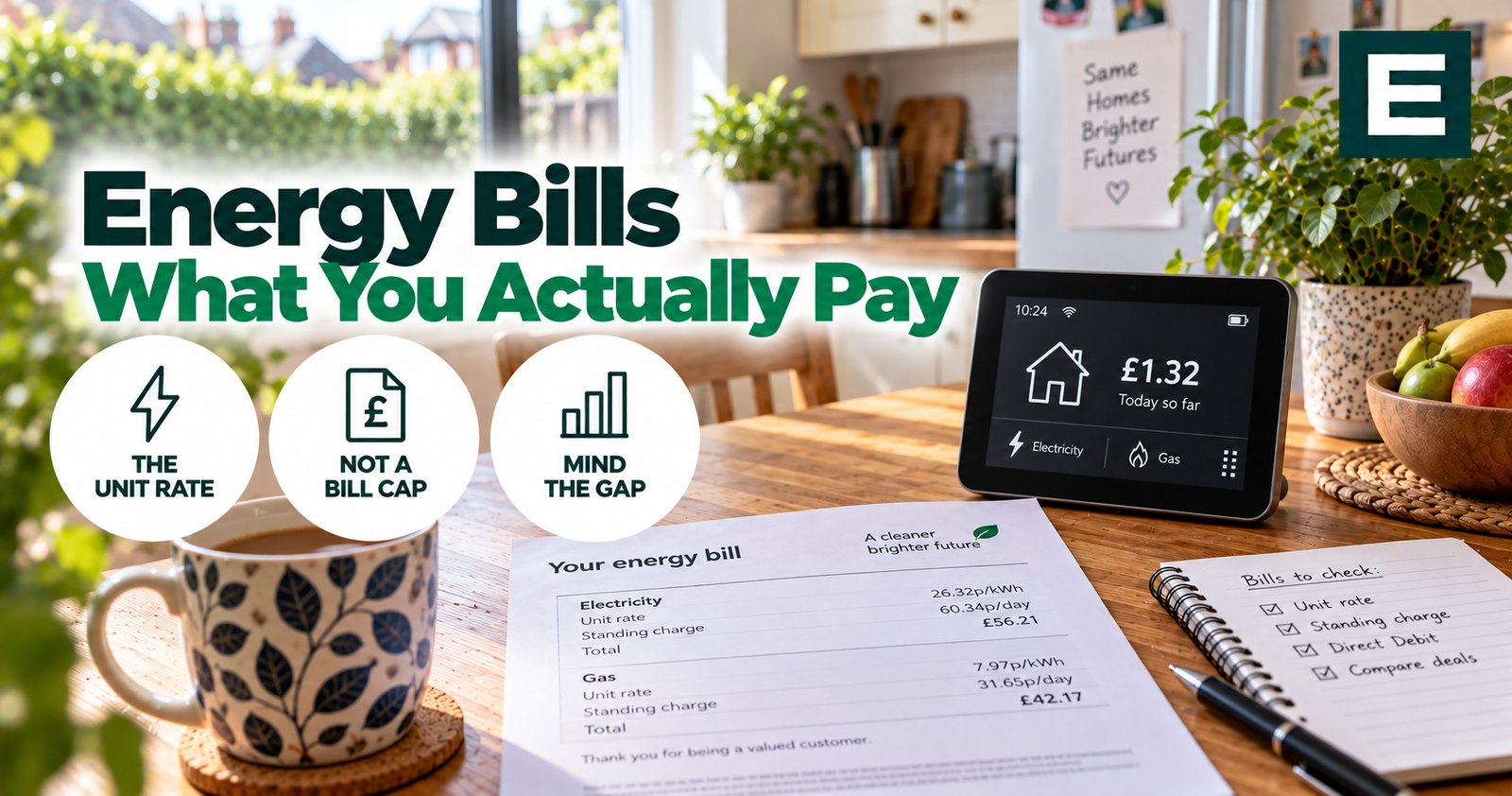
Every decision on this site comes back to one number: what you pay for a unit of electricity or gas. Whether a heat pump beats a gas boiler, whether solar pays back in twelve years or twenty, whether a battery is worth buying at all. Change the unit rate and every answer changes with it.
This section explains how that number is built, who decides it, and which parts of it you can actually do something about.
How an energy bill is actually built
Two components per fuel, and almost every argument about energy bills is really an argument about one of them.
The unit rate is what you pay per kilowatt hour of what you use. It is the number that matters for every calculation on this site.
The standing charge is a fixed daily amount you pay whether or not you use anything. It covers network costs, meter provision and the cost of supplier failures. If you have both gas and electricity, you pay two of them.
That second one explains something people find baffling: a household that uses almost no energy still gets a bill. It is also why removing a gas supply entirely, rather than just not using it, is worth real money over a year. We break down where the money goes in our guide to standing charges.
What the price cap actually caps
The Ofgem price cap is the single most misunderstood thing in UK energy, and the misunderstanding is in the name.
It does not cap your bill. It caps the unit rate and the standing charge a supplier can charge on a default tariff. If you use more, you pay more, without limit. The widely reported figure for “the average household” is an illustration based on assumed consumption, not a ceiling on what anyone pays.
Three other things worth knowing:
- It changes every three months, announced in advance and taking effect on the first of January, April, July and October. Any figure you read has a date attached whether the page shows it or not.
- It applies to default tariffs only. If you are on a fixed deal or a time-of-use tariff, the cap does not set your price.
- It varies by region. Network costs differ across Great Britain, so the cap is not a single national number.
The practical consequence: “the price cap went up” tells you almost nothing about what happened to your bill. In 2026 the headline figure also stopped being comparable with previous years, for two separate reasons, which we set out in the energy price cap explained.
The figures we use across this site
Everything on The Energy Upgrade that involves a running cost uses the same two numbers, so you can always check our arithmetic.
| Measure | Rate |
|---|---|
| Electricity, per kWh | 26.32p |
| Gas, per kWh | 7.97p |
| Gas heat at 85% boiler efficiency | 9.4p per kWh of heat |
Ofgem price cap for 1 October to 31 December 2026. These change quarterly and we update them across the site when they do. If the date above is more than three months old, check the current cap before relying on any figure that depends on it.
Why the gap matters more than the rate
Here is the idea that runs through everything else in this section, and it is worth understanding once properly.
Very little in home energy is decided by the headline price of electricity. Almost everything is decided by the gap between two prices.
- Heat pumps turn on the gap between the electricity rate and the gas rate, adjusted for how efficiently each turns fuel into heat.
- Solar turns on the gap between what you pay to import and what you are paid to export. A unit you use is worth the import price; the same unit exported is worth a fraction of it.
- Batteries turn on the gap between off-peak and peak electricity, which is why they pay back through tariff arbitrage rather than through storing sunshine.
- Standing charges turn on nothing at all, which is precisely the complaint.
Once you see it that way, some counterintuitive things follow. A higher electricity price makes solar better and heat pumps worse. A better export rate makes a battery less worthwhile, not more. Neither of those makes sense until you are thinking in gaps rather than prices.
Time-of-use tariffs, and what they change
A standard tariff charges the same unit rate whatever time of day it is. A time-of-use tariff does not: it charges less overnight and more at peak, usually early evening.
That matters for three groups of people, and nobody else:
- Anyone with a battery, who can buy cheap and avoid buying dear
- Anyone with an electric car, where the overnight charge is a large, movable load
- Anyone with a heat pump, which can pre-heat a cylinder or the fabric of the house during cheaper windows
If you have none of those, a time-of-use tariff usually makes your bill worse rather than better, because your consumption is concentrated in exactly the hours it charges most for. On typical rates you need to move around 17% of your electricity into the cheap window just to break even, and we show the arithmetic in our guide to time-of-use tariffs.
The trade-off is real and it is not only financial. These tariffs reward attention. If you are not willing to think about when you run things, the saving will not materialise.
None of this works without a smart meter that is actually communicating with your supplier, and around one in twelve in Great Britain is not. Our guide to smart meters covers what to check before you sign up to anything that depends on one.
Why we do not publish a tariff comparison table
You will find plenty of sites listing supplier rates. We do not, for the same reason we do not publish export rate tables.
Tariff prices change without notice, comparison pages go stale quietly, and restricted deals get quoted as though anyone can have them. A table that is wrong is worse than no table, because it looks authoritative.
What we publish instead is the mechanism: how these tariffs work, what a saving depends on, and how to check what you would actually pay. That stays true after every price change. When we do quote a figure, it carries the date it was checked.
What you can and cannot control
A useful way to think about where effort is worth spending.
You cannot control the price cap, the standing charge on your region’s network, wholesale gas prices, or what your supplier decides to charge next quarter.
You can control which tariff you are on, when you use electricity, how much heat your house loses, and whether you generate any of your own. Only the last of those costs money.
That ordering matters. Shifting when you use electricity is free and can be worth more than a subsidised installation. We keep coming back to it because it keeps being true.
The guides in this section
Four guides, in the order they are most useful read.
The energy price cap explained
What the cap actually limits, who it covers and who it does not, and why it changes every quarter. Also the two changes in 2026 that mean this year’s headline figure cannot be compared with last year’s, which Ofgem acknowledges and almost nobody reporting the cap mentions.
Standing charges explained
What the 84.5p a day pays for, why the electricity charge is nearly twice the gas one, and why it rose so sharply in 2026. Also the catch in lower standing charge tariffs, which Ofgem itself says are unlikely to reduce bills, and why they are almost exactly the wrong choice for a heat pump household.
Time-of-use tariffs and what load shifting is worth
Why a cheaper night comes with a dearer day, and the break-even point that decides whether you gain or lose. Worked figures for an electric car, a heat pump and a battery, and the questions to ask before switching.
Smart meters
The prerequisite for every time-of-use tariff and every solar export payment. How much of Great Britain has one, why roughly one in twelve is not working as a smart meter at all, and what to check with your supplier before you rely on yours.
The running cost arithmetic also appears in full on whether a heat pump is worth it and whether solar panels are worth it, and the export side is covered on solar export rates.
Last updated 21 September 2026. Unit rates from the Ofgem price cap for 1 October to 31 December 2026. The price cap is set quarterly and varies by region, so the figures above are national averages for a direct debit customer on a default tariff. Smart meter operating figures from DESNZ’s quarterly smart meter statistics. We do not publish supplier tariff comparisons; check rates with suppliers directly. Written by Ben Jardine.