
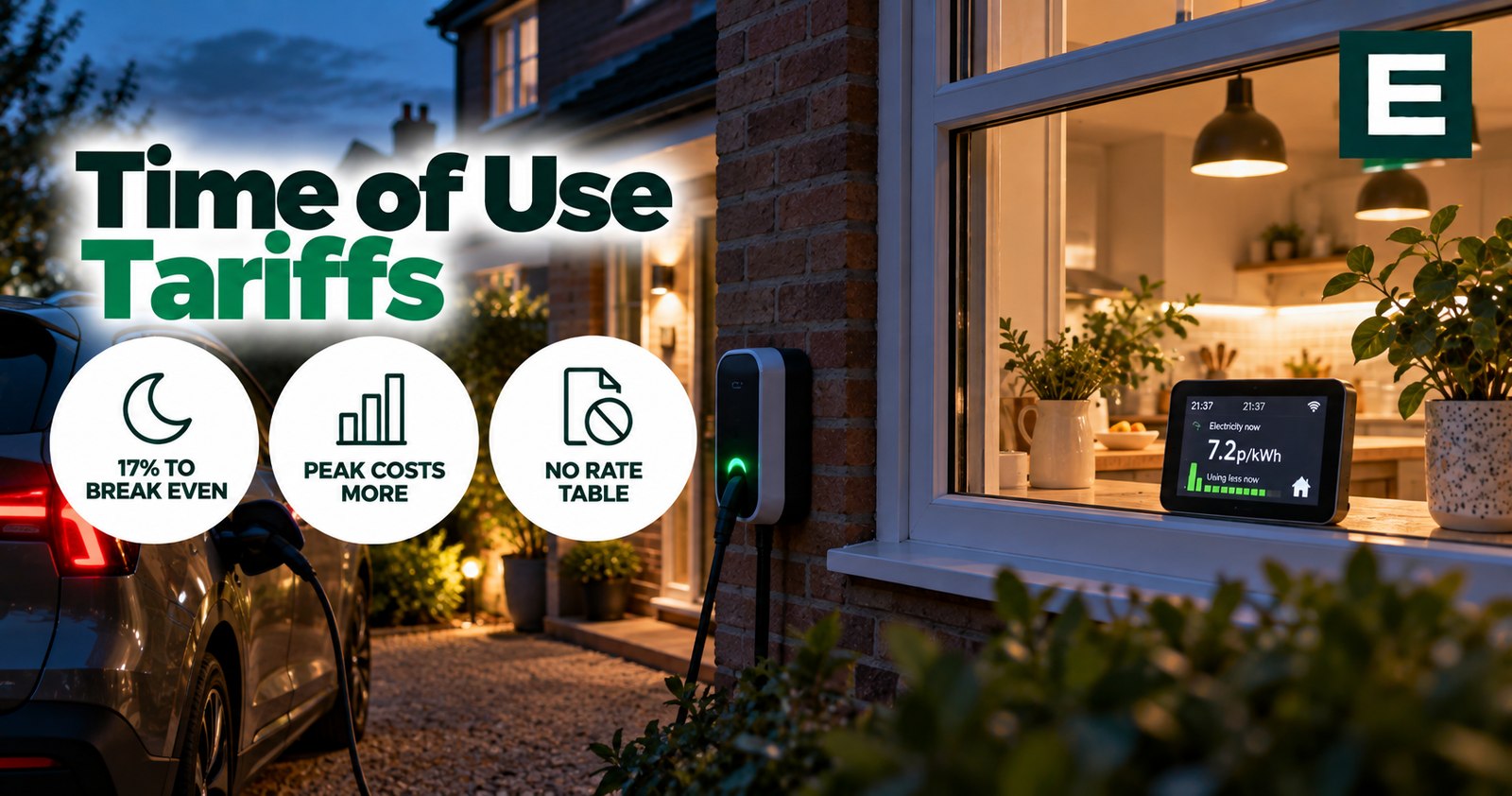
A time of use tariff charges you less overnight and more during the day. Every guide frames that as free money. It is not: you are trading a cheaper night for a dearer peak, and whether you come out ahead depends entirely on how much of your consumption you can move.
On typical rates the break-even is around 17% of your electricity shifted into the cheap window. Below that you lose money. This page shows the arithmetic and what each piece of equipment is actually worth.
The part nobody mentions
A standard tariff charges one rate all day. Under the Ofgem price cap for 1 October to 31 December 2026 that is around 26.32p per kWh.
A time of use tariff splits the day. The overnight window might be 7p or 8p. The daytime rate is higher than the standard rate, often around 30p.
That second half gets left out of almost every explanation. You are not being given cheap electricity. You are being offered a different shape of pricing, and the supplier is not doing it out of kindness: they want your demand moved off the evening peak, and they are paying you to move it by charging you more if you do not.
So a time of use tariff is a bet on your own behaviour. Win it and the savings are substantial. Lose it and your bill goes up.
The break-even, worked through
A household using 2,900 kWh of electricity a year, standard rate 26.32p, time of use rates of 8p off-peak and 30p peak.
| Shifted to off-peak | Annual cost | Against standard tariff |
|---|---|---|
| Nothing | £870 | £107 worse |
| 17% | £763 | Break-even |
| 30% | £679 | £84 better |
| 50% | £551 | £212 better |
| 70% | £423 | £340 better |
Our calculation. The 8p and 30p figures are illustrative of the shape of a typical two-rate tariff, not a quote from any supplier. Your own rates will differ, but the mechanism does not.
The number that matters is 17%. That is the proportion of your total electricity you need to move overnight before you are better off than you were.
A household with no battery, no electric car and no heat pump typically shifts perhaps 10% to 15% without changing how they live: a dishwasher on a timer, a washing machine set to run late. That sits either side of break-even, which means for most ordinary households a time of use tariff is close to pointless and can be mildly negative.
Add one large movable load and the picture changes completely.
What each piece of equipment is worth
The saving from any device is the same calculation every time: the kWh you can move, multiplied by the gap between the two rates. On the illustrative rates above the gap is 22p.
An electric car
The strongest case by a distance. A car doing 8,000 miles a year at around 3.5 miles per kWh uses roughly 2,300 kWh, and almost all of it can be charged overnight while you sleep.
That is 2,300 kWh moved at a 22p gap, or around £500 a year. It also nearly doubles your total consumption, which pushes your shifted proportion well past break-even on its own.
If you have an electric car and you are not on a time of use tariff, this is the single most valuable thing on this page.
A heat pump
Good, but less clean than a car, and the reason is worth understanding.
A heat pump in a typical home uses somewhere around 3,000 to 4,000 kWh of electricity a year. Hot water is easy to shift: heat the cylinder overnight and it is there in the morning. Space heating is harder, because you need warmth when it is cold, and it is coldest when electricity is dearest.
What you can do is pre-heat, running the system harder during the cheap window so the building coasts through the expensive one. How well that works depends on how well your house holds heat, which brings the whole thing back to insulation.
Realistically, shifting 30% to 50% of heat pump consumption is achievable in a reasonably insulated house. On 3,500 kWh that is around £230 to £385 a year.
One caution. Pre-heating means running the heat pump at a higher flow temperature or at times when the outside air is coldest, and both reduce its efficiency. You are trading some efficiency for a cheaper unit rate. On these numbers that trade is usually worth making, but it is a trade, not a free gain.
A battery
A battery is the only one of the three that exists purely to do this. It charges at the cheap rate and discharges at the dear one, whether or not the sun shone and whether or not you were paying attention.
A 10 kWh battery cycled daily moves around 3,650 kWh a year, worth roughly £800 at a 22p gap. Against an installed cost of £4,000 to £10,000, that is where the ten year payback figures come from.
Which leads to the conclusion we reach on our batteries page: if a battery pays for itself through this, it is doing so as an energy trading device rather than as a solar accessory, and it would pay back at much the same rate with no panels at all.
The types of tariff you will meet
Economy 7 and Economy 10. The original time of use tariffs, decades old, giving seven or ten cheaper hours overnight. Still widely available and often the only option where a home has storage heaters. The daytime penalty tends to be steep.
Fixed-window smart tariffs. The modern version: a defined cheap period, usually a few hours in the small hours, with a higher rate the rest of the time. Simple to plan around.
EV-specific tariffs. A cheap overnight window, sometimes conditional on having a particular charger or proving you own an electric vehicle. Read the conditions: some restrict the cheap rate to the car alone rather than the whole house.
Heat pump tariffs. A newer category, usually requiring proof of an installed heat pump. Some offer cheaper rates across more of the day rather than only overnight, which suits a heating load better than a two-rate structure does.
Dynamic or agile tariffs. Prices that change every half hour, following the wholesale market, published a day ahead. The potential saving is the largest of any option and so is the risk: prices can spike hard on cold still evenings. These suit people who genuinely enjoy optimising, and nobody else.
What you need before any of this works
- A smart meter that reports half-hourly. Without it your supplier cannot tell what you used when, so they cannot bill you differently by time of day. This is the same requirement that governs export payments under the Smart Export Guarantee.
- Something worth shifting. Covered above. If the answer is a dishwasher, the answer is probably no.
- A willingness to pay attention, at least at first. The savings above assume the shifting actually happens.
Why we do not publish a tariff comparison table
Tariff rates change without notice, comparison pages go stale quietly, and restricted deals get quoted as though anyone can have them. We found the same problem when we looked at solar export rates: nine current guides, contradicting each other by a factor of five.
So the useful thing is not a table. It is knowing what to ask:
- What are both rates, off-peak and peak, and exactly what hours does the cheap window run?
- Does the cheap rate apply to the whole house or only to a specific device?
- What is the standing charge? Some time of use tariffs carry a higher one, which eats into the saving before you have moved a single kilowatt hour.
- Are there conditions? A particular charger, a particular battery, an installation by that supplier, a fixed term with an exit fee.
- What happens if the rates change? Fixed for a term, or variable at the supplier’s discretion.