
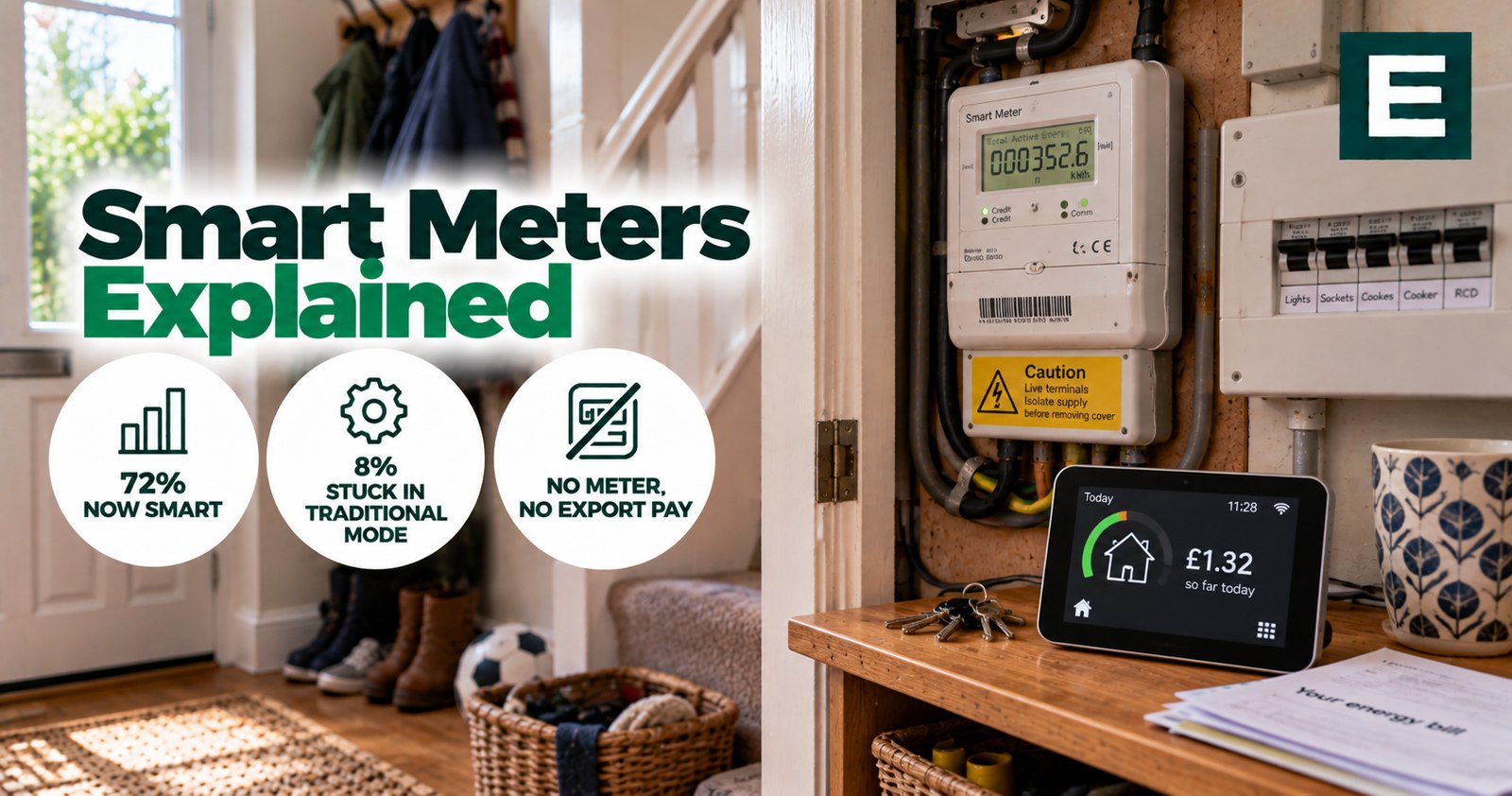
Solar export payments and every time-of-use tariff on the market have one thing in common: neither works without a smart meter that is actually communicating with your supplier. This page covers what that means in practice, how much of Great Britain currently has one, and what to check before you assume yours is doing its job.
What a smart meter actually does
A smart meter records how much gas and electricity you use and sends readings automatically to your supplier over the Data Communications Company (DCC) network, the shared infrastructure that connects meters across Great Britain to whichever company you switch to. That is the whole difference from an older meter: no estimated bills, no someone reading a dial, and, critically for this page, a record of when you used electricity, not just how much.
That timing detail is what unlocks two things this site covers a lot: getting paid for solar you export to the grid, and paying less for electricity you use at certain times of day.
Why solar export payments need one
The Smart Export Guarantee, the scheme that pays you for electricity your panels send to the grid, requires a smart meter capable of half-hourly readings as a condition of the scheme itself, alongside MCS certification of the installation. Without one, there is no mechanism for your supplier to know how much you exported, so there is nothing to pay you for.
This is not a technicality a supplier could waive if it wanted to. See our guide to export rates for how they themselves work, and why we do not publish a rate table.
Why time-of-use tariffs need one
A time-of-use tariff charges a different rate depending on when you use electricity, cheaper overnight, more expensive at peak times. Your supplier can only bill you that way if it knows what you used in each half-hour window, which means the same half-hourly smart meter data as the export scheme, just used to charge you rather than pay you. A meter that only reports a single monthly or quarterly total cannot support this kind of tariff at all.
We cover the arithmetic of whether shifting your usage is worth it, including our own working on the break-even point, in our guide to time-of-use tariffs.
How much of Great Britain actually has one
The rollout has been running for over a decade and is still not complete.
| What the rollout looks like, end June 2026 | Figure |
|---|---|
| Smart and advanced meters in homes and small businesses, end June 2026 | 42 million |
| Share of all GB meters that are smart or advanced | 72% |
| Of those, share operating in full smart mode (sending automatic readings) | 92% |
| Share still working like an old-style meter despite being smart hardware | 8% |
That last row matters more than it looks. Roughly one in twelve smart meters in Great Britain is not actually behaving like one, which is the subject of the next section.
SMETS1, SMETS2, and meters stuck in “traditional mode”
Not every smart meter installed is a smart meter working. Early first-generation devices (SMETS1) sometimes lost their smart functionality when a household switched supplier, though most have since been migrated onto the shared DCC network and recovered it. Second-generation meters (SMETS2) were built to avoid that problem from the outset.
Either generation can end up in “traditional mode”, meaning it still measures usage correctly but has stopped communicating automatically, usually because of a weak signal, a supplier-side fault, or a switch that has not fully migrated the meter. If you are relying on a smart meter for the Smart Export Guarantee or a time-of-use tariff, a meter stuck in traditional mode is functionally the same as not having one. Ask your supplier to check its status and, if it is not in smart mode, to fix it or replace it.
The government has set energy suppliers an obligation to take all reasonable steps to reach 100% domestic smart meter coverage by 31 December 2030, following its response to a consultation on the post-2025 policy framework. That is a target for installing meters, not a guarantee every one of them keeps working.
Do you have to accept a smart meter?
No. There is no legal obligation on households to have one, and you can decline. If your existing meter needs replacing and you refuse a smart one, your supplier may struggle to source an old-style replacement, since production of non-smart meters has largely stopped, and you can ask for a smart meter’s communications to be switched off so it runs in “dumb” mode instead.
The trade-off is direct: a meter you have declined, or one running in dumb mode, cannot support the Smart Export Guarantee or a time-of-use tariff, for the same reason a meter stuck in traditional mode cannot. Ofgem’s own guidance is blunt about this: refusing a smart meter can mean a more limited choice of tariffs, some of which would otherwise be cheaper.
What is coming: market-wide half-hourly settlement
Underneath all of this is a bigger industry change called market-wide half-hourly settlement (MHHS), an Ofgem-sponsored programme delivered by Elexon that is moving the whole GB electricity market onto half-hourly settlement between individual suppliers and the wholesale system, not just individual customer tariffs. Migration started in autumn 2025 and is scheduled to run through to around May 2027, with full completion targeted for July 2027.
For most households this happens in the background and needs no action from you. The practical relevance is that it is the same underlying shift, from estimated and averaged consumption to actual half-hourly data, that already makes the Smart Export Guarantee and time-of-use tariffs possible today. It is worth knowing the name if you see it mentioned on a bill or in supplier correspondence over the next couple of years.
What to actually do if you are planning solar or a time-of-use tariff
Before you budget for export income using our solar payback calculator, or switch to a time-of-use tariff expecting the cheaper rates to apply automatically, check three things with your supplier:
- Whether you have a smart meter at all, and if so which generation.
- Whether it is currently operating in smart mode rather than traditional mode.
- Whether it is a SMETS2 (or fully migrated SMETS1) meter, since some older or unmigrated meters are not accepted by every tariff or by every Smart Export Guarantee provider.
Suppliers can usually tell you this over the phone or through your online account. If your meter is not in smart mode, ask what is needed to fix it before you sign up to anything that depends on it.
Frequently asked questions
These are the questions we are asked most often about smart meters and solar or tariff eligibility.
Do I need a smart meter to have solar panels installed?
No. Generating and using your own solar electricity does not require a smart meter. You only need one to receive Smart Export Guarantee payments for electricity you send to the grid.
Can I get Smart Export Guarantee payments without a smart meter?
No. A smart meter capable of half-hourly readings is a condition of the scheme, alongside MCS certification of the installation.
My meter is smart but I am not sure it is working properly. What do I check?
Ask your supplier whether it is operating in smart mode or traditional mode. Roughly 8% of smart meters in Great Britain are stuck in traditional mode, meaning they measure usage correctly but do not send automatic readings, which rules out both export payments and time-of-use tariffs until it is fixed.
Do I have to accept a smart meter if my supplier offers one?
No, there is no legal obligation. You can refuse, or ask for an existing smart meter’s communications to be switched off. Doing so limits your choice of tariffs, including ruling out time-of-use tariffs and Smart Export Guarantee payments.
What is market-wide half-hourly settlement and do I need to do anything about it?
It is an industry-wide reform moving the whole GB electricity market onto half-hourly settlement, running from autumn 2025 to around mid-2027. It happens at supplier and network level and does not require action from most households.
Last updated 21 September 2026. Rollout and smart-mode figures from DESNZ’s Smart meters in Great Britain quarterly update to June 2026, published 27 August 2026. The 2030 rollout obligation is from the government’s response to the Smart Metering Policy Framework Post 2025 consultation, published March 2026. Smart Export Guarantee requirements are Ofgem scheme rules. The market-wide half-hourly settlement timeline is Ofgem’s MHHS programme, delivered by Elexon. The right to refuse a smart meter follows Ofgem guidance as summarised by Which?. No figures on this page are our own calculation. Written by Ben Jardine.