
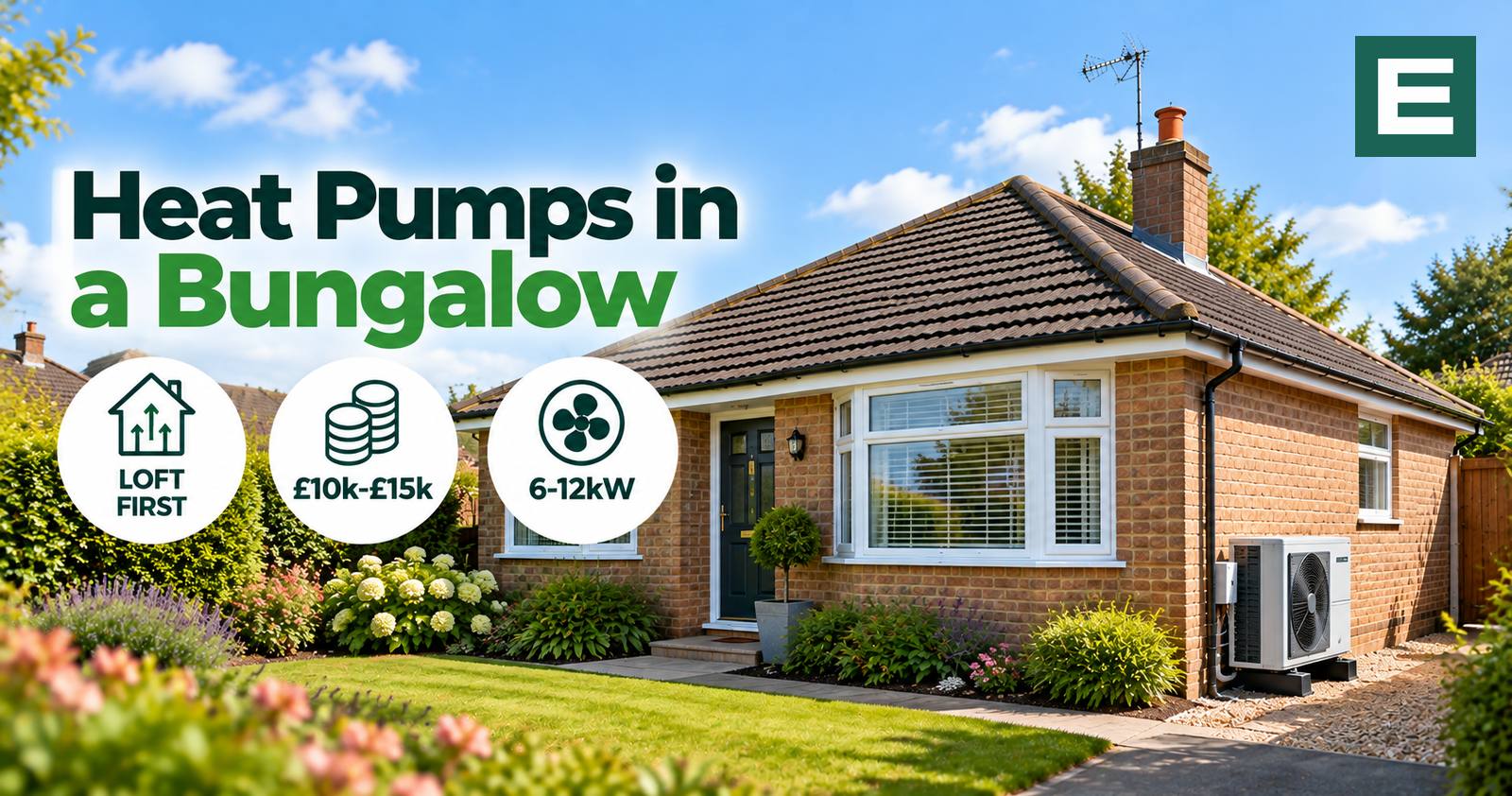
A heat pump in a typical bungalow costs £10,000 to £15,000 installed, or £2,500 to £7,500 after the £7,500 Boiler Upgrade Scheme grant. If you are off the gas grid on oil or LPG, which many bungalows are, the grant rises to £9,000 until 31 March 2027 and the net cost drops accordingly.
The bungalow is a study in contradictions. It has the worst fabric heat loss of any common house type, and it is also the easiest property to fit a heat pump into. This page explains both, and why the second usually matters more than the first.
Why a bungalow loses more heat
This is geometry rather than construction quality, and it applies to every bungalow regardless of age.
In a two-storey house, the roof sits above half the floor area and the ground floor sits below the other half. In a bungalow, the roof is above all of it and the floor is below all of it. Same number of bedrooms, twice the roof, twice the ground floor.
Roofs and floors are where a lot of heat goes. So a three-bedroom bungalow typically has a higher heat demand than a three-bedroom two-storey house of the same floor area, even when both are built to the same standard.
That sounds like bad news. It is actually the most actionable thing on this page, because it cuts both ways.
The loft is the cheapest win available to any property type
If the roof covers your entire floor plan, then insulating it improves your entire floor plan. Loft insulation in a bungalow does roughly twice the work it does in a two-storey house of the same size, for the same cost per square metre.
It is also usually the easiest loft in the country to work in: a straightforward cold roof space, level access across the whole footprint, no awkward room-in-roof geometry.
So the first thing to do in a bungalow is check the depth of what is up there. The current standard is 270mm. A great many bungalows were insulated to 100mm or less when built and never topped up. Going from 100mm to 270mm is a few hundred pounds of work and it will reduce the size of heat pump you are quoted for, which reduces the price of the heat pump itself.
Do this before the survey, not after. The heat loss calculation is done on the house as it stands. Insulate afterwards and you have paid for capacity you no longer need.
The floor, which is harder
The other half of the geometry problem is less tractable.
Post-war bungalows, which is most of them, typically have solid concrete ground floors. Unlike a suspended timber floor, you cannot insulate a concrete slab from below, and insulating from above means lifting floor levels, which affects door heights and thresholds throughout.
In practice most people leave it. It is worth knowing about as a limit on how far the fabric can be improved rather than as a job to plan.
The exception is if you are already re-laying floors for another reason. A solid floor is the ideal substrate for underfloor heating, which is the most efficient emitter a heat pump can have, and a bungalow’s single-level layout makes a whole-house installation straightforward. That is a significant project, but if it is happening anyway, doing it at the same time as the heat pump is far cheaper than doing it twice.
Why installers like bungalows
Now the good half. Almost everything about the physical installation is easier here.
- Somewhere to put the outdoor unit. Bungalows usually come with a decent plot. Airflow, access for servicing and distance from neighbours’ windows are rarely the problem they are in a terrace or a flat.
- Short pipe runs. Everything is on one level. No first-floor radiators, no lifting upstairs floorboards, no vertical risers.
- Somewhere for the cylinder. Many bungalows have a garage, utility or large airing cupboard. Cylinder space is the blocker that stops projects in flats and terraces and it is rarely an issue here.
- Cavity walls, usually fillable. Bungalows built from the 1950s onward almost always have cavity walls. Unlike a 1930s semi there is little ambiguity, and an unfilled cavity is the second cheapest improvement after the loft. Pre-war bungalows may be solid, so check rather than assume.
That combination is why a bungalow install often comes in below what its heat demand alone would suggest. The system may need to be a little larger, but the labour is lower and the awkward extras are fewer.
If you are off the gas grid
Bungalows are over-represented in villages and rural areas, which means a disproportionate number are heated by oil or LPG rather than mains gas. If that is you, the case is much stronger than for a gas-heated property, for two reasons.
The grant is larger. £9,000 rather than £7,500 for an air-to-water or ground source heat pump in a property off the mains gas grid currently heated by oil or LPG, running from 21 July 2026 to 31 March 2027.
The running cost comparison is not close. Oil delivers heat at roughly 12.0p to 12.8p per kWh. A heat pump at a seasonal efficiency of 3.0 delivers it at about 8.8p on the current price cap. Against gas the margin is thin; against oil a heat pump wins comfortably.
The definition of off-gas-grid is stricter than people assume, and a capped meter still counts as being on the grid. Our guide to the £9,000 oil and LPG grant covers the disqualifiers.
If you are in Scotland, none of this applies: the Boiler Upgrade Scheme does not operate there. See heat pump grants in Scotland instead, where the rural uplift works differently and is not time-limited.
One further point if you are rural: a bungalow with a large plot is one of the few property types where ground source is worth considering. It costs considerably more, £20,000 to £30,000 installed for the same £7,500 grant, but if you have the land, a long time horizon and no mains gas, the arithmetic is less lopsided than it is elsewhere.
What it costs
| Measure | Figure |
|---|---|
| Median air source install, all properties, 2025/26 | £13,021 |
| Middle half of all installs, April to June 2026 | £11,128 to £15,627 |
| Typical bungalow, our estimate | £10,000 to £15,000 |
| After the £7,500 grant | £2,500 to £7,500 |
| After the £9,000 off-grid rate | £1,000 to £6,000 |
Install costs from DESNZ Boiler Upgrade Scheme Statistics. The property-type estimate is ours, not an official figure.
The range is wide because bungalows vary enormously, from a compact two-bedroom on a small plot to a sprawling four-bedroom with extensions. Floor area drives the heat demand and the heat demand drives the system size. A dormer bungalow, with rooms in the roof, behaves more like a two-storey house and will usually cost somewhat less than a true single-storey one of the same floor area.
A point about how you use the house
Heat pumps suit steady, continuous operation. They run for long periods at a low flow temperature rather than blasting radiators hot and shutting off, which is how a gas boiler behaves.
That has a practical consequence often left out of these comparisons. If the house is occupied during the day and you want it at a consistent temperature rather than heating it in two short bursts, a heat pump is working the way it is designed to and the efficiency figures hold up. If the house is empty all day and you want it warm within half an hour of getting home, you are asking the system to do the thing it is worst at.
This is not about bungalows specifically. It is worth raising here because it changes the answer for a lot of households and almost nobody mentions it.
When the answer is no
A working boiler and no insulation budget. The geometry means an uninsulated bungalow has a genuinely high heat demand. A heat pump will work but the system will be large and the running costs disappointing. Loft first.
You are on mains gas with a recent boiler. The running cost saving against gas is small and may be nil. Nothing is forcing your hand: the proposed 2035 phase-out for existing homes was dropped from the Warm Homes Plan in January 2026.
A solid-walled pre-war bungalow with no plan for the walls. Same argument as a Victorian terrace, but with more roof and floor loss on top.
The order to do things in
- Measure the loft insulation. If it is under 270mm, top it up. Biggest effect per pound in this property type.
- Check whether the cavity is filled. If the bungalow is post-war and the cavity is empty, fill it.
- Draughtproof, particularly around the loft hatch, which in a bungalow sits directly above living space.
- Decide about the floor. Usually leave it, unless you are re-laying anyway, in which case consider underfloor heating.
- Then get quotes, so the heat loss calculation reflects the improved house.
For the full cost picture see what a heat pump actually costs, for the running cost arithmetic see whether a heat pump is worth it, and for the grant rules see the Boiler Upgrade Scheme.
Frequently asked questions
These come up most often from bungalow owners.
Are bungalows good candidates for a heat pump?
Practically, yes. Space for the outdoor unit, short pipe runs, room for a cylinder and usually a fillable cavity. The offsetting factor is that a bungalow loses more heat through its roof and floor than a two-storey house of the same floor area, so the system needs to be sized accordingly.
Why does a bungalow need a bigger heat pump than a house the same size?
Because the roof covers the whole floor plan rather than half of it, and so does the ground floor. More roof and more floor means more fabric heat loss for the same number of rooms.
What size heat pump does a bungalow need?
Commonly 6 to 12kW depending on floor area and insulation, but that must come from a room-by-room heat loss calculation. The spread between a small and a large bungalow is wider than for most property types.
Do I need to insulate the loft first?
It is the single most worthwhile thing you can do, and it should happen before the survey rather than after. A bungalow loft covers the entire property, so topping it up to 270mm reduces the system size you are quoted for.
Can I get the £9,000 grant for a bungalow?
Only if the property is off the mains gas grid and currently heated by oil or LPG, and the application is made before 31 March 2027. It is about the fuel and the connection, not the property type, though bungalows are more likely than average to qualify.
Is underfloor heating worth it in a bungalow?
If you are re-laying floors anyway, it is worth serious consideration. It is the most efficient emitter for a heat pump and a single-storey layout makes a whole-house installation straightforward. As a standalone retrofit into an existing solid floor it is a major and disruptive project.
Last updated 15 September 2026. Install costs verified against DESNZ Boiler Upgrade Scheme Statistics. Grant values and eligibility verified against Ofgem’s published scheme guidance. Energy prices from the Ofgem price cap for 1 October to 31 December 2026. Property-type cost estimates are our own and are flagged as such. Written by Ben Jardine.